
Blog 3 in series: In this blog, the third in the series on navigating the path to SAP S/4HANA, we focus on choosing your SAP cloud endpoint. Previously, we explored the strategic case for the move and the preparation required to get there. Now it is time to make a defining decision. We compare on-premises and SAP Cloud across control, cost structure, data sovereignty, updates, total cost of ownership, and security posture. We also look at hybrid hyperscaler options and traditional virtualisation, and show how the right hosting model depends on infrastructure, cost, security, and risk tolerance.
Blog 3 in S/4HANA navigation series
SUMMARY: This blog, the third in the series, focuses on choosing your SAP cloud endpoint for S/4HANA. It compares on-premises and SAP Cloud across control, cost structure, data sovereignty, updates, total cost of ownership, and security posture. It examines hybrid hyperscaler options and traditional virtualisation, including VMware vSphere, Proxmox / KVM, and Nutanix AHV, highlighting certification, cost profile, and risk, and shows how the right hosting model depends on infrastructure, cost, security, and risk tolerance.
Welcome to the third blog in our series on navigating the path to SAP S/4HANA. In previous blogs, we explored the strategic case for the move and the preparation required to get there. Now it is time to make a defining decision: choosing your SAP cloud endpoint.
Choosing your endpoint
Once the strategic case for moving to S/4HANA is settled, one question remains: where should the system actually run? The next two blogs in this series tackle that question from opposite directions.
This blog focuses on hosting S/4HANA yourself, whether through hybrid hyperscaler platforms such as AWS and Azure, or traditional on-premises virtualisation.
Choosing where your S/4HANA system physically lives is one of the most consequential decisions you will make while planning your migration. It dictates your level of control, your financial model, your security posture, and how quickly you can adopt AI-driven capabilities. This blog breaks down the real differences between on-premises and public cloud deployments, compares the leading hyperscaler and virtualization options, and frames the total cost of ownership so you can make a clear-eyed decision.
Our next blog, Blog 4, looks at the alternative, being SAP’s own cloud routes – RISE with SAP and GROW with SAP – and how each shapes your licensing, custom code, and the role your implementation partner plays.
It’s worth remembering that RISE and GROW are not required to reach S/4HANA ahead of the 2027 and 2030 support deadlines; they are two options among several, and for organisations that want to retain control over infrastructure, cost, or security, hosting outside SAP’s managed cloud is an equally valid route.
Read together, these two blogs map the full range of S/4HANA endpoints, so you can weigh what SAP manages for you against what you can manage yourself – just as capably.
On-premises versus SAP Cloud: The strategic divide
In 2026, the gap between ‘on-premises’ and ‘public cloud’ has narrowed considerably, thanks to hybrid hyperscaler solutions like AWS Outposts and Azure Stack. Yet the choice still carries significant implications for control, cost structure, and innovation velocity.
Here is how the two models compare through the lens of an S/4HANA migration:
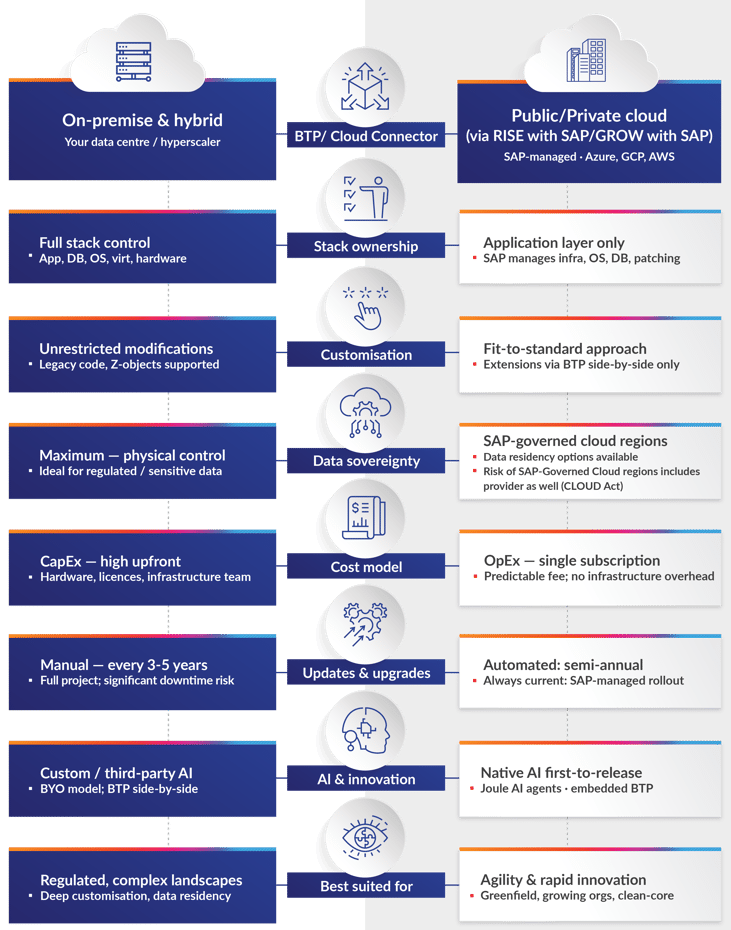
Architectural and strategic differences
| Feature | On-premises (Any-premise) | SAP Cloud |
|---|---|---|
| Control | Total. You manage the OS, DB, and application layers. High customisation (including modifications) is allowed. | Restricted. SAP or the provider manages the stack. Focus is on ‘Fit-to-Standard’ (configuration only). |
| Updates | Manual. You choose when to upgrade; often every 3–5 years. | Automatic/Planned. Semi-annual or annual updates pushed by SAP. |
| Hardware | Your data centre or local hyperscaler hardware (e.g., AWS Outposts). | Shared/multi-tenant or private cloud on global regions. |
| Data sovereignty | High. Physical data resides on your site; ideal for defence, government, or strict regulatory sectors. | Medium. Data resides in a provider's region (though 'Sovereign Cloud' options now exist in the EU and US). |
On-premises versus SAP Cloud: Advantages and trade-offs
Migrating to S/4HANA introduces real complexity when deciding on a hosting model. Understanding the advantages and trade-offs of each path is essential before committing.
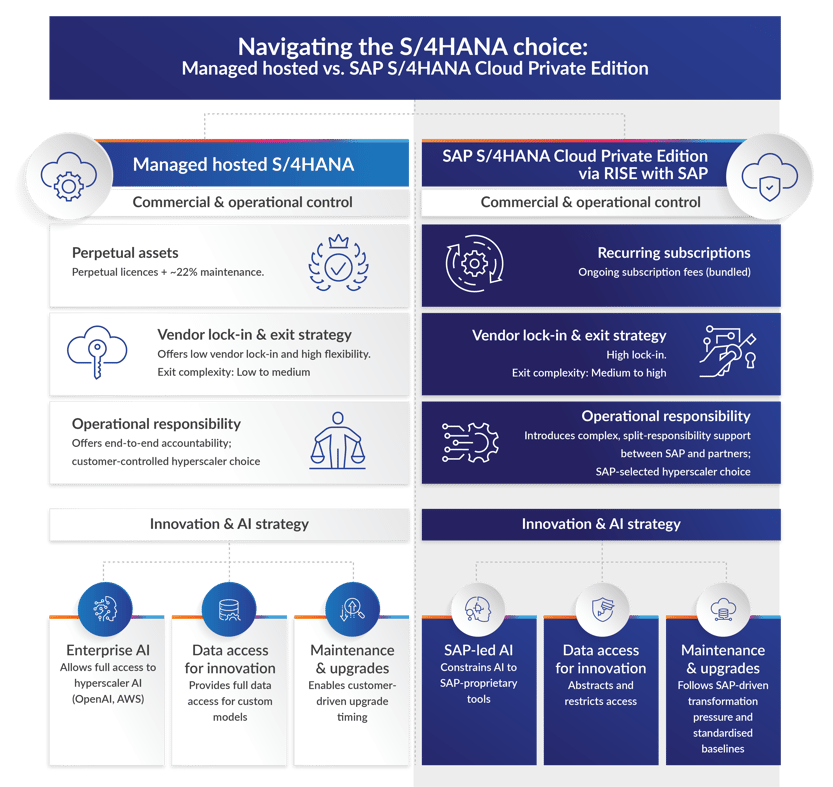
| Dimension | On-premises | SAP Cloud ERP Private |
|---|---|---|
| Vendor Lock-In | Low | High |
| Hosting/Hyperscaler | Customer Controlled | SAP Controlled |
| Exit Complexity | Low–Medium | Medium–High |
| Contract Flexibility | High | Low |
| Cloud and AI applications | Options including SAP Joule | Confined to propriety SAP |
| Planning | N/A | Assessment |
| Clean Core | Work towards | Quality Gate |
| Approach | N/A | Brownfield (technical migration), Greenfield (new start), or selective data transition (SDT) |
| Timeline | N/A | 6-18 months |
| Effort | N/A | Effort high for complex landscapes but supported by tools and partners |
| Total SAP Landscape | N/A | Additional Cost for migration. Disruption during and after |
Example case study
Our client is evaluating whether to remain on its current partner-hosted S/4HANA platform or migrate with ‘RISE with SAP’. The current hosted model offers higher flexibility and lower long-term costs, while SAP S/4HANA Cloud Private Edition via RISE with SAP provides SAP-led management, but with potential constraints.
Hybrid hyperscalers: Cloud power in your data centre
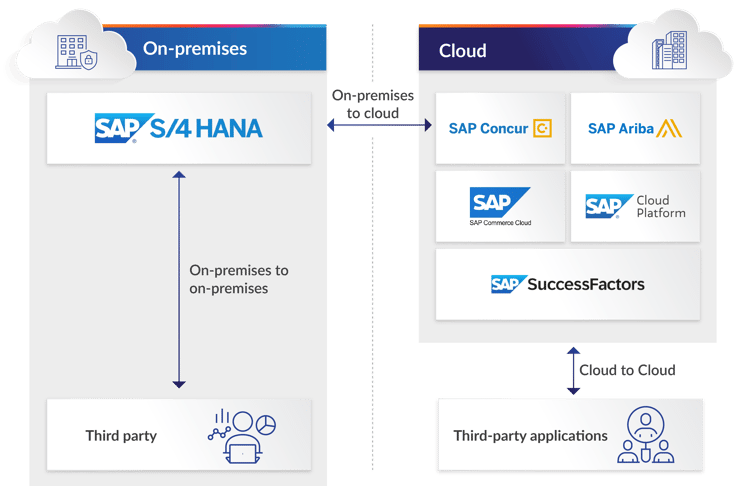
If you choose not to move to SAP S/4HANA Cloud Public Edition or SAP S/4HANA Cloud Private Edition, you have an option to host S/4HANA while maintaining full control. The most modern approach is the hybrid hyperscaler model: cloud-grade hardware installed in your own facility, managed through the same console you would use in the public cloud.
Traditional hardware and virtualisation: The classic path
If you prefer traditional infrastructure without the hyperscaler subscription layer, the 2026 hardware market is focused on HANA-optimised appliances. Staying away from the cloud means you take on the responsibility of SAP certification compliance – and SAP is very strict about which hypervisors can run productive HANA workloads.
VMware vSphere: The safe enterprise bet
VMware remains the ‘gold standard’ for on-premises SAP. Most SAP notes and best practices are written first for VMware.
- Certification: Fully certified for S/4HANA and HANA.
- Pros: Features like vMotion (live migration) and DRS (load balancing) are natively supported for SAP. It has the largest ecosystem of SAP-aware backup tools (Veeam, Cohesity).
- Cons: Since the Broadcom acquisition, licensing costs have increased significantly. The move toward per-core subscription models can be expensive for large HANA nodes.
Proxmox and KVM: The open-source alternative
In 2026, many organisations are evaluating Proxmox to escape VMware licensing. However, there is a critical certification catch:
- The status: Proxmox VE is not officially certified by SAP for productive S/4HANA workloads.
- The workaround: SAP does certify KVM – the engine under Proxmox – but specifically the SUSE Hypervisor (SLES for SAP Applications) or Red Hat Virtualization versions.
- The risk: Running production S/4HANA on standard Proxmox means SAP Support may refuse to assist with kernel-level performance issues until you replicate the problem on bare metal or a certified hypervisor.
- Best use: Proxmox is excellent for sandbox, development, and training environments to reduce costs, while production stays on a certified platform.
Nutanix AHV: The middle way
Nutanix has gained massive traction in 2026 as the primary alternative to VMware for SAP workloads.
- Certification: Fully certified for SAP HANA.
- Pros: Uses its own hypervisor (AHV), based on KVM but fully hardened and supported by both Nutanix and SAP. It offers ‘one-click’ simplicity and a more predictable cost model than VMware.
- Cons: Requires Nutanix-specific hardware or certified nodes – you cannot install it on any generic ‘white box’ server the way you can with Proxmox.
Virtualisation platform comparison (2026)
| Feature | VMware vSphere | Nutanix AHV | Proxmox / KVM |
|---|---|---|---|
| SAP Production Certified? | Yes | Yes | KVM only (SLES/RHEL) |
| Management Focus | Enterprise IT Teams | Hybrid Cloud / HCI | Linux / Open-Source Admins |
| Cost Profile | High (Subscription) | Medium-High (Appliance) | Lowest (Community/Support) |
| Live Migration | Supported for HANA | Supported for HANA | Restricted for HANA |
Total cost of ownership: Managed Hosted vs. SAP Cloud ERP Private
Understanding the financial model is as important as understanding the technology. Here is how the two primary hosting approaches compare across the key cost dimensions:
| Dimension | Managed Hosted | SAP Cloud ERP Private |
|---|---|---|
| Software | License maintenance (fixed) | Subscription fees |
| Infrastructure / Platform | Optimisable: you control the levers | Less opportunity for cost optimisation |
| Support | Support services (scalable) | Fixed as part of subscription; additional support services scalable |
| Migration Cost | N/A | Medium to High |
| ROI | Predictable | Dependent on scope |
Security considerations
Security is a critical factor in any hosting decision. On-premises deployments give you direct, physical control over your security perimeter – from network segmentation and firewall rules to encryption key management and access governance. SAP Cloud Private/Public deployments shift much of this responsibility to SAP and the hyperscaler, which brings enterprise-grade compliance certifications but reduces your ability to enforce bespoke security policies. Hybrid models land somewhere in between, often requiring a shared responsibility framework that must be clearly defined during project planning.
How can we help you?
EPI-USE Labs has global experts capable of supporting any type of migration or managed service, including:
- SAP Basis Managed Services:
End-to-end management and support of SAP environments using experienced Basis specialists and proprietary automation tools. This covers incident management, change request management, daily monitoring, system health checks, performance management, and landscape housekeeping — all underpinned by 24/7 global support centres. - BRIDGE Managed Services:
A complementary managed service designed specifically for organisations who have migrated to SAP via RISE with SAP. It fills the gaps left by SAP's Cloud Enterprise Services, covering areas like daily landscape health checks, job monitoring, transport management, performance management, and coordination with SAP for upgrades, refreshes, and system copies. - Cloud Management Services (Full-Stack):
A comprehensive, end-to-end managed cloud offering covering both SAP and non-SAP workloads across private and public cloud environments. This includes infrastructure management, real-time monitoring, patch updates, incident and change management, and access to EPI-USE Labs' automation IP via the Client Central platform. - Cloud Migrations:
A structured, accelerated migration service to move SAP systems to the cloud, including Selective Data Transition using a proprietary migration methodology called PRISM. Rather than a simple lift-and-shift, the service optimises and rationalises the SAP landscape, includes data integrity validation, data masking for compliance, and supports rehosting or refactoring approaches across AWS, Azure, and GCP. - Private Cloud Hosting:
Our iSphere Cloud solution offers secure, flexible private cloud infrastructure for SAP and non-SAP workloads, hosted in top-tier global data centres via Equinix and Teraco (Africa). Offerings include dedicated and leveraged private cloud, Backup-as-a-Service, and Disaster Recovery-as-a-Service, all built on Fujitsu hardware and independent hypervisor infrastructure. We also offer client-owned hardware/provider managed options. We protect your data sovereignty by building your cloud around your requirements anchored in your chosen jurisdiction, and fully managed by our engineering team across every layer of the stack. - SAP on AWS:
Infrastructure and managed services for SAP workloads running on Amazon Web Services. As an AWS Premier Tier Services Partner and AWS SAP Consulting Competency Partner, the team provides migrations, architecture design, optimisation, and ongoing management of SAP environments including S/4HANA, ECC, and BW/4HANA on AWS. - SAP on Azure:
Infrastructure and managed services for SAP workloads on Microsoft Azure. As a Microsoft Gold Partner, the team delivers lean, secure, and resilient SAP landscapes on the Azure platform, including migrations and ongoing management.
In closing
Regardless of the hosting model you choose, your security posture must account for SAP-specific concerns: transport management, role-based access controls, audit logging, and data masking for non-production environments. The right approach depends on your industry, regulatory landscape, and risk tolerance — and it should be a first-order consideration in your endpoint decision, not an afterthought.
Explore the rest of the blog series
This is Blog 3 in a multi-part series on navigating the path to S/4HANA. Explore previous blogs:
Blog 1: S/4HANA navigation path: How to chart your course
Blog 2: S/4HANA navigation path: How to prepare for lift-off
and read the next in the series:
Blog 4: S/4HANA navigation path: What's the difference between SAP S/4HANA Cloud Private and Public Editions?
Blog 5: S/4HANA navigation path: AI integration
Blog 6: S/4HANA navigation path: SAP Cloud project support during and post go-live
Blog 7: S/4HANA navigation path: Standard project support during and post go-live