
How will AI shape your SAP S/4HANA migration? In 2026, AI is no longer an experimental add-on; it is a proven accelerator embedded across the entire migration lifecycle. From discovery through to post-go-live optimisation, AI compresses timelines, reduces risk, and positions your new platform for autonomous operations from day one. In this blog, the fifth in our S/4HANA navigation series, we explore how AI accelerates the S/4HANA migration lifecycle across discovery, migration, and post-go-live optimisation.
Blog 5 in S/4HANA navigation series
SUMMARY: In this blog, the fifth in our S/4HANA navigation series, we explore how AI accelerates the S/4HANA migration lifecycle across discovery, migration, and post-go-live optimisation. We look at process mining, predictive complexity scoring, clean core validation, automated data mapping, AI-generated test scripts, and Joule for Developers to reduce risk, shorten timelines, and improve operational efficiency. EPI-USE Labs' Semantik platform, Joule, AWS Kiro Agents, SAP Cloud ALM, and SAP AI Units support code remediation, governance, observability, and autonomous operations in the Agentic Enterprise state.
How will Artificial Intelligence (AI) shape your SAP S/4HANA migration? In 2026, AI is no longer an experimental add-on; it is a proven accelerator embedded across the entire migration lifecycle. From discovery through post-go-live optimisation, AI compresses timelines, reduces risk, and positions your new platform for autonomous operations from day one.
EPI-USE Labs has launched AI-enabled platforms to turn ambitious digital strategies into practical enterprise solutions. Central to this initiative is Semantik, providing the trusted semantic foundation needed to seamlessly accelerate the SAP S/4HANA adoption journey through its diverse suite of products.
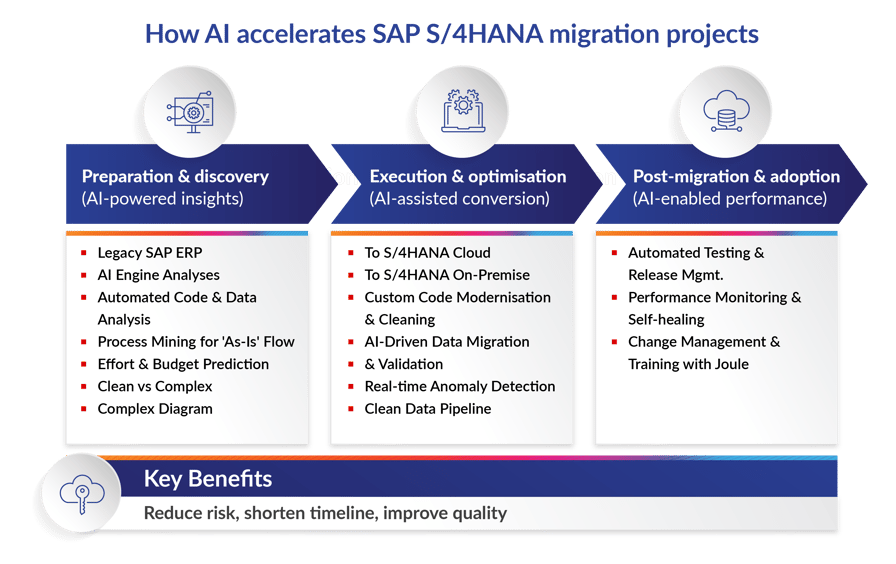
There are three distinct phases where AI delivers measurable value in an S/4HANA conversion or migration project: Discovery, Migration, and Post-Go-Live Optimisation.
| Migration Phase | Primary Executive Value | AI Mechanism | EPI-USE Labs' Semantik Offerings |
|---|---|---|---|
| Discovery | Budget and Timeline Certainty | Gain insights into your landscape and enable machine learning to predict the exact effort required to fix custom code. | Semantik Map |
| Migration | Risk Reduction | Automated testing simulates peak business workloads to prevent go-live failures. | Semantik Flow |
| Post-Go-Live | Operational Efficiency | AI agents autonomously resolve supply chain and logistics exceptions. | Semantik Pulse |
Phase 1: AI-powered discovery and assessment
Before moving a single table, AI helps you understand the full scope of what you are migrating – and what you should leave behind.
- Process mining (SAP Signavio): AI agents analyse your actual ECC transaction logs to identify shadow processes and bottlenecks. Instead of manual workshops, AI provides a data-driven map of where you can standardise versus where you must retain custom logic.
- Predictive complexity scoring: Advanced discovery tools use machine learning to scan custom ABAP code. They do not just find errors – they predict the effort required to remediate code based on historical patterns from thousands of other migrations.
- Clean core validation: AI assistants map your legacy customisations to modern BTP-based side-by-side extensions, ensuring you do not pollute your new S/4HANA core with technical debt carried over from ECC.
- Custom Code migration AI assistant: This is your starting point for understanding issues that arise when converting custom code from ECC to S/4HANA. It explains ABAP Test Cockpit (ATC) findings in detail – including the corresponding simplification notes – covering data model and data type changes, deprecated functionality, and incompatible changes to SAP development objects.
With EPI-USE Labs' Semantik Map solution, you can analyse your legacy system's complexity with agentic AI. Identify potential migration bottlenecks and uncover deep structural insights, turning massive data sets into an actionable roadmap for your SAP S/4HANA journey.
Phase 2: Intelligent execution (the migration phase)
The actual move is where AI eliminates manual labour and mitigates risk at scale.
- Automated data mapping: AI-assisted ETL (Extract, Transform, Load) tools suggest mappings between legacy ECC tables and the unified S/4HANA Universal Ledger. The system identifies data quality issues – duplicate vendors, inconsistent addresses – and suggests fixes before the load happens.
- AI-generated test scripts: Using SAP Cloud ALM, functional requirements are automatically converted into test scripts. AI predicts performance bottlenecks by simulating synthetic workloads that mimic your peak business periods, ensuring business continuity through the transition.
- Joule for developers: Your team can use generative AI (Joule) to accelerate the rewriting of legacy ABAP into ABAP Cloud syntax, significantly shortening the Brownfield remediation timeline.
Understanding SAP AI Units
SAP AI Units are the virtual currency – similar to cloud credits – used for premium AI capabilities across your SAP landscape.
- Joule Base (No Units Required): Foundational tasks like basic navigation, information retrieval, and simple summarising are included within your existing SAP cloud licenses (S/4HANA, SuccessFactors, etc.).
- Joule Premium (AI Units Required): Complex, generative, or agentic workflows require AI Units. This includes specialised modules like Joule for Developers, Joule for Consultants, and advanced financial or supply chain insights.
With EPI-USE Labs' Semantik Flow solution, you can accelerate your SAP S/4HANA transition with secure, predictable modernisation outcomes. Leverage pre-build migration accelerators, intelligent orchestration, and AI-assisted pre-built data mapping to rapidly shift from legacy systems to a modern digital core.
Phase 3: The agentic transformation (post-go-live)
The goal of a 2026 migration is not just to reach S/4HANA – it is to reach the Agentic Enterprise state (or Autonomous Enterprise state), where your ERP actively drives outcomes rather than passively recording them.
- Autonomous workflows: Beyond simple automation, Agentic Orchestration handles exceptions end-to-end. If a procurement disruption is detected, an AI agent can autonomously suggest alternative suppliers or initiate re-routing of logistics – without waiting for a human to triage the alert.
- Joule deep research: Users no longer just run reports. They ask Joule complex questions like "Why is our DSO (Days Sales Outstanding) increasing in the APAC region?" Joule synthesises internal S/4HANA data with external market intelligence to deliver a strategic answer.
- Continuous observability: SAP Cloud Logging and Cloud ALM use ML-based anomaly detection to flag technical or business process issues before they cause downtime.
With EPI-USE Labs' Semantik Pulse solution, you can maintain continuous visibility over your SAP S/4HANA data health. Set up automated alerts with the data changes to notify data degradation or gap with the new environment.
What AI modules are available?
SAP Joule (In SAP Cloud)
Joule is SAP’s generative AI copilot designed to act as a unified, natural-language interface across the entire SAP cloud ecosystem. Unlike general-purpose chatbots, Joule is "business-aware," meaning it understands your specific enterprise data, business processes, and the underlying SAP data structures.
Joule Base (No Additional Cost) and Joule Premium (Paid Tier) are the two levels available for use. For an effective Clean Core strategy in 2026, you should use a combination of both, but Joule Premium (specifically the Joule for Developers and Joule for Consultants entitlements) provides the critical "agentic" capabilities required to automate the transition.
While Joule Base helps you navigate and learn, Joule Premium does the heavy lifting of code refactoring and governance automation.
AWS Kiro (SAP Cloud and On-Premise)
AWS recently introduced Kiro Agents specifically to help SAP customers manage the transition to S/4HANA. These are open-source AI agents that automate the evaluation of custom ABAP code.
- Code Assessment: It scans thousands of legacy ABAP objects in hours, not weeks.
- Classification: It uses AI (via Amazon Bedrock) to categorise code as "to be retired," "to be remediated," or "to be moved to BTP."
- Remediation Guidance: It provides specific suggestions for fixing code violations that block S/4HANA upgrades, helping you keep your SAP core "clean."
AWS provides a specialised extension for the Kiro IDE called SAP Power. This brings domain-specific SAP expertise directly into the development workflow.
- Multi-Framework Support: It understands the syntax and best practices for SAP CAP (Cloud Application Programming Model), SAPUI5, ABAP, and SAP BTP.
- Auto-Activation: When you open a .cds, .abap, or manifest.json file, the SAP Power agent activates automatically to provide context-aware suggestions.
- Integration with BTP: It can help scaffold and deploy applications directly to the SAP Business Technology Platform using natural language prompts.
| Phase | Key AI Tool | Primary Benefit |
|---|---|---|
| Assess | AWS Kiro Agents | Rapidly classifies legacy code (A-D levels). |
| Remediate | Custom Code Migration (ATC) | Proposes AI-generated code fixes for ABAP Cloud. |
| Build | Joule for Developers | Ensures new extensions are "side-by-side" and clean. |
| Govern | SAP Cloud ALM + Joule | Monitors technical debt and methodology compliance. |
How much time and cost does AI actually save?
By 2026, the integration of AI and process-mining tools into the S/4HANA migration lifecycle has moved from experimental to a proven driver of efficiency. Here is what the data shows:
| Migration Phase | AI-Driven Reduction | Notes |
|---|---|---|
| Discovery & Assessment | 40–50% time reduction | Process mining tools like Signavio replace weeks of manual workshops. |
| Code Adaptation | 30–40% time reduction | Joule for Developers accelerates ABAP remediation. ROI typically achieved within the first 14 months. |
| Project Setup | 10–16% time reduction | Joule Project Setup Agents automate configuration scaffolding. Costs calculated via SAP AI Units. |
| Testing & QA | 30–50% time reduction | AI-powered automated testing generates test cases and reduces manual rework. |
Data security and governance
Because Joule acts as an agent on your behalf, SAP has built in several layers of Sovereign AI protections. Here is how this impacts your security posture and internal governance.
Data security: The vaulted tenant model
SAP's 2026 security architecture ensures your sensitive business data is never used to train public AI models.
- Tenant isolation: All AI reasoning and data grounding occur within your private SAP BTP subaccount. Your code, financial figures, and process metadata are logically isolated from other customers.
- Zero-training clause: SAP explicitly guarantees that your data is not shared with third-party LLM providers for model training. The AI uses your data to answer your prompt, then discards the specific context once the session ends.
- Data masking: During the Discovery phase, AI tools typically analyse metadata and transactional headers rather than PII (Personally Identifiable Information), ensuring GDPR and CCPA compliance by design.
Internal governance: The human-in-the-loop mandate
Governance in 2026 is not about blocking AI – it is about orchestrating it. Your internal teams shift their focus from doing the work to approving the work.
- Role-Based Access Control (RBAC): Joule inherits your existing SAP authorisations. If a user does not have permission to see executive salaries in S/4HANA, Joule cannot retrieve that data for them – even if they ask in natural language.
- Auditability & Traceability: Every code change or process optimisation suggested by the AI includes a citation sidebar. You can see exactly which SAP Note, Best Practice document, or internal code snippet the AI used to justify its decision.
Authorisation and performance
What authorisation does the AI require?
The level of access evolves as the project progresses:
- Discovery Phase: Access to your SAP systems is read-only via RFC Connections or SAP Cloud ALM Integration. Service keys ensure secure connections.
- Migration and Change Phases: The AI transitions from a 'Consultant' role to a 'Developer' role. Write and execute access is required, strictly governed by SAP's Sovereign AI security framework. Access over a cloud connector is recommended for these activities.
Will AI monitoring degrade system performance?
The SAP AI stack – Joule, Signavio, and LeanIX – uses an asynchronous, event-driven architecture. The impact is minimal:
- CPU overhead: Typically less than 3% during active discovery.
- Memory impact: Negligible. The AI does not store its knowledge base in your local HANA memory – it uses a vector database on BTP.
- Network latency: Minor (milliseconds) due to the optimised Cloud Connector tunnel.
How does the AI handle dynamic ABAP logic?
Because dynamic ABAP does not reveal its data structures until runtime, AI uses a three-step Reasoning & Planning flow:
- Semantic trace: Instead of just reading the code, Joule uses the SAP Knowledge Graph to trace where the data originates – identifying whether a dynamic table is pulling from a specific set of OData services or CDS views.
- Static mapping of dynamic patterns: AI recognises common legacy dynamic patterns and maps them to modern ABAP Cloud equivalents, such as the RESTful ABAP Programming (RAP) model.
- Code explanation agent: If the logic is too opaque, Joule generates a human-readable explanation of the intent behind the dynamic logic, enabling your developers to make informed remediation decisions.
Executive Q&A
Technical Deep-Dive Q&A
Explore the rest of the blog series
This is Blog 5 in a multi-part series on navigating the path to S/4HANA. Explore the rest of the series:
Blog 1: S/4HANA navigation path: How to chart your course
Blog 2: S/4HANA navigation path: How to prepare for lift-off
Blog 3: S/4HANA navigation path: On-premises endpoints and hyperscaler hosting
Blog 4: S/4HANA navigation path: What's the difference between SAP S/4HANA Cloud Private and Public Editions?
Blog 6: S/4HANA navigation path: SAP Cloud project support during and post go-live
Blog 7: S/4HANA navigation path: Standard project support during and post go-live