
I wasn’t in Las Vegas for SAP Connect this year, so I did what many of you will have done. I watched the keynotes on replay, read every announcement SAP published, and then read what the analysts and user groups made of it a week later. I then discussed my analysis with our team who attended in person to understand what I might have missed from the partner event and from the in-person discussions, to round off my thoughts.
SUMMARY: SAP’s Autonomous Enterprise is right about the direction, and early on the timing. The data comes before the agent: get master data in order, archive old data, protect personal data and build Production-like test systems with before-and-after checks before switching on write access. EPI-USE Labs’ classic products and Semantik platform help customers do the work below the waterline. Partners bring value by extending SAP’s agents and building new ones. Every Semantik journey starts with Semantik Map (in Beta), a read-only assessment of what is really in your SAP system.
I wasn’t in Las Vegas for SAP Connect this year, so I did what many of you will have done. I watched the keynotes on replay, read every announcement SAP published, and then read what the analysts and user groups made of it a week later. I then discussed my analysis with our team who attended in person to understand what I might have missed from the partner event and from the in-person discussions, to round off my thoughts.
SAP’s announcement quoted Christian Klein: “The Autonomous Enterprise has arrived.” The keynote backed it up with assistants, agents, and a new way of working with Joule across finance, HR, procurement and supply chain. Yet SAP’s own HCM team, writing the next day, still called Autonomous HCM “our vision for the future”.
My perspective is that SAP is right about the direction, and early on the timing. SAP has shipped a great deal since May, and Moor Insights gave it credit for delivering on what it promised at Sapphire. But most of what was announced reaches their customers between now and early 2027; and SAP switches it on for customers who hold the right licences. I don’t say that to knock SAP: the world is moving that much faster.
What was the most useful advice at SAP Connect?
The most useful advice of the week came from the customers SAP invited onto its stage, and they all said the same thing in different words.
Novartis kept it short: “get your data in order first.” Morgan Foods listed what they had learned: “the right data, master data, the right business processes. Develop them, have them clean, have them documented.”
Nestlé, which runs S/4HANA across more than 140 countries, was blunter still: “It’s only when the underlying data is harmonized and trustworthy that you can deploy AI that can make a difference at our scale.”
The data comes before the agent, and it was good to hear SAP’s own customers say so from SAP’s stage.
What about the icebergs?
Marielle Ehrmann, SAP’s Chief Security Officer, closed with an image I know well: “When people look at AI, they see what is above the waterline. The agent, the demo, the answer. But what determines whether AI can actually run in Production sits below the waterline.”
Her list of what sits below included regulation, tax law, data residency, and identity and access.
As we build out our new Semantik platform, I draw the same iceberg, the same way up. Above the waterline is what everyone sees: the agent, the demo, the answer, running in Production. Below it, next to everything on her list, sits the data: test and training copies, sandboxes, and old systems kept alive for compliance, all holding copies of the same people and transactions.
Agents get built and tested down there before they go live, so the personal data in those copies needs the same care as it gets in Production. We work on both sides of the line, and on the part most people miss, which is moving data between the two with every link intact.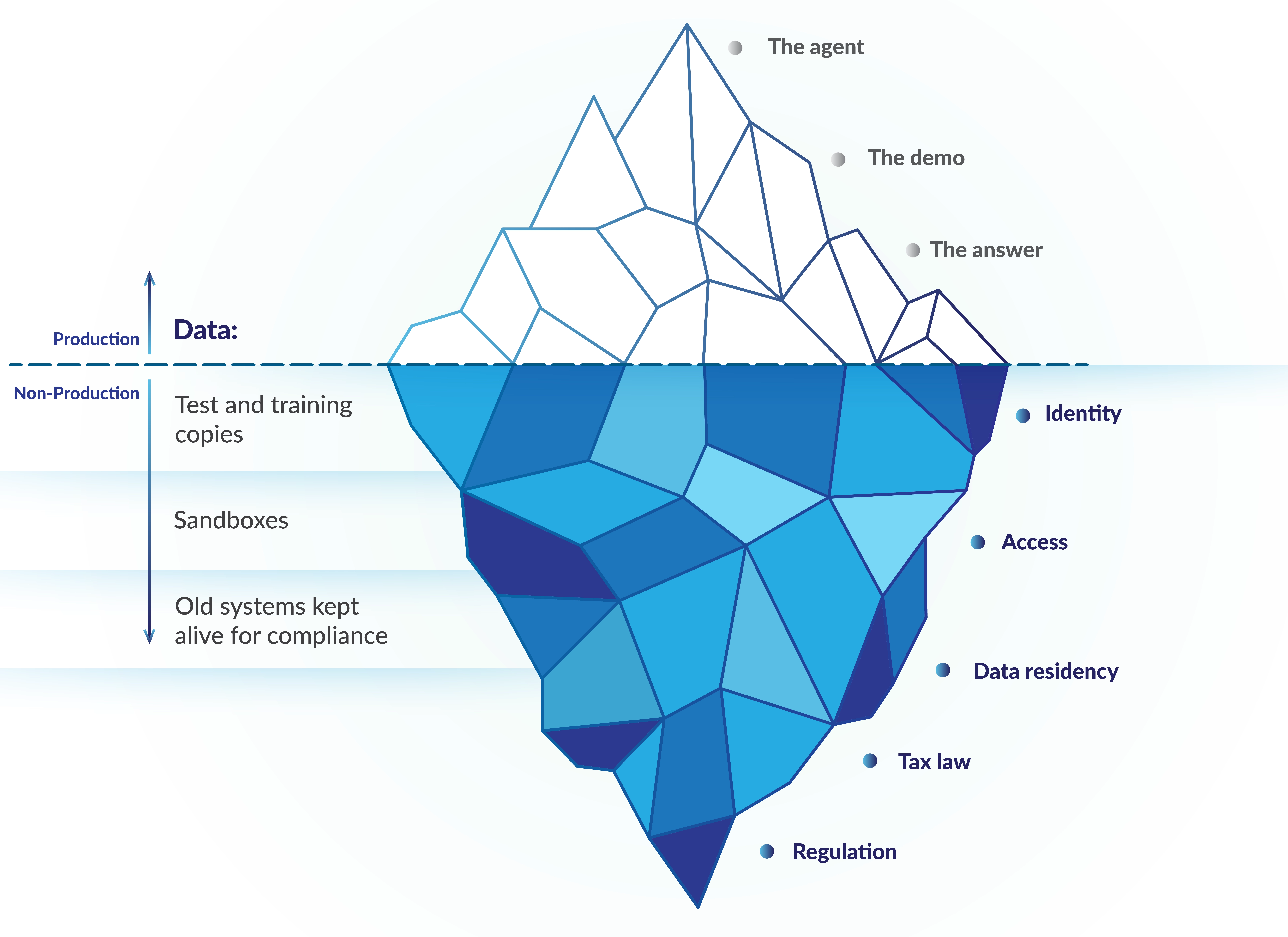
Agents that write need somewhere to rehearse
Christian Klein was clear that customers decide the level of autonomy, and that you “can also deploy your agents fully autonomous with write-back rights into our applications". SAP’s guide lists assistants and agents arriving across finance, procurement, supply chain, customer experience and HR through to early 2027. In the SAP SuccessFactors keynote, SAP described a concept in which connected agents update an employee’s role, pay and training.
Would you let a new hire post journal entries on their first day? Would you let an untested change go straight into Production? So why would you switch on an agent with write access before you have seen what it does with your data?
Rehearsing an agent means a test system that behaves like Production, with the personal data in it masked, and proof of what changed once the agent has acted. EPI-USE Labs’ classic products already do this work for SAP customers on whichever journey to the cloud they’re on. Archive Central retires the old data and slims up the systems; Data Sync Manager builds Production-like test systems; Data Secure masks the personal data in them; and Variance Monitor compares the results before and after a change.
SAP sees the same need: its Test Management Assistant includes a Test Data Management Agent. The test data agent we’re building will be callable from Joule alongside it.
Give your agents a clean, lean system to work in
The agents in SAP’s demos work on your live system, and in many SAP systems that means years of history nobody touches from one month to the next. SAP’s Sebastian Steinhaeuser warned customers against paying “incredible token bills for something that they could have fixed at the database level”, as Forrester reported. His point was wider than archiving, but archiving is one of those database-level fixes, and I’d put it near the top of any AI plan.
Move the old data out of the live system, keep every record retrievable for when an auditor or a regulator asks, and your agents work on a lean, current system. Consolidation makes this more pressing. One customer at SAP Connect is going from 890 HR systems towards 60, and the systems they switch off still hold data that has to be kept or retired properly.
The documents attached to all that history need a home too. We’re working on an exciting new offering that will let you retain these documents in your cloud and geography of choice while using the SAP standard APIs, and then extend our data protection capabilities to this unstructured data.
Payroll: 25 years of proving it’s right
The SuccessFactors keynote showed Joule surfacing every unresolved payroll issue and tracing one to a missing state tax code. On October 7, SAP wrote that its payroll assistants are 'available this month'. That’s good news for payroll teams.
We have been helping payroll managers prove their payroll is right for 25 years with Variance Monitor, and we do it deterministically: the same comparison, run the same way, before and after every change. When an agent starts making some of those changes, that evidence becomes more important, because someone still has to show the result is right.
Through Semantik, we are now focused on the next problem. A global food and beverage company came to us with payroll, HR, incentive and sales systems from different vendors that don’t agree with each other. Finding the differences is the easy part. What they need is to resolve them across every one of those systems, upstream and downstream of payroll, and that is what we are building towards.
What SAP’s knowledge graph can’t see on its own
Klein described SAP’s knowledge graph as mapping “more than 7 million data fields, half a million tables, over 50,000 APIs.” Forrester’s response was measured and, I think, right: “These vendor-reported figures indicate scope. They do not prove semantic accuracy inside a customer environment”.
SAP’s knowledge graph describes SAP’s software in real depth, and Joule is better for it. No vendor’s model knows on its own what is actually in your system: your customisations, the years of data you have built up, the copies outside Production, and the systems you are about to retire.
I’m glad SAP has put its weight behind encapsulated knowledge and rules, and it makes sense for SAP to build a differentiated agentic experience on top of it. What I’ll be watching is how open SAP keeps the path to your own SAP data.
We are fortunate to have built up a knowledge graph over the past 23 years that is the brain of our classic Data Sync Manager (DSM) suite. It’s been proven across just about any use case one can imagine in the proverbial SAP iceberg: copy, redact, compare, scramble, provision and more. Being a graph junkie has its uses, and it’s exciting to see that graph put to full use as we help our clients on their agentic journeys.
A word as an SAP Partner
EPI-USE Labs has been an SAP Partner for more than 30 years, so I have concerns when I read SAP's guide where it describes Cloud ERP integrations ‘delivered, maintained and upgraded by SAP’, ‘without the need for separate integration projects’. It also describes new process consulting tools that help business teams find where agents fit ‘without relying on IT or external consulting’.
When I speak to SAP customers, it's clear how much they value the Partner network and that they see the benefit of engaging with Partners to bring value from this AI moment.
SAP’s message to partners at its Partner Summit was more encouraging. Its own inventory, as of 1 October, already counts 69 Joule assistants and 430 agents across finance, supply chain, spend, HR and customer experience. SAP told partners it expects to cover about 80 to 90% of what customers need and wants partners to own the rest: extending SAP’s agents, building new ones on the SAP Business AI Platform with any tools and exposing them through MCP, and listing them in SAP Discovery Center and the AI Agent Hub. That’s where we’re heading. The agents we build will be callable from Joule and registered in the AI Agent Hub, alongside SAP’s own.
One gap remains. Joule can call a Partner’s agent today, but SAP’s architecture pages say a Partner’s agent can’t yet call back into Joule. I’d ask SAP to close it, because customers will get to the Autonomous Enterprise faster with Partners alongside them.
What I’d do now
CIOs pay attention: the next two quarters are preparation time, and you can turn that into an advantage.
- Get the data your first agents will touch in order. Start with the master data they will read and write: customers, suppliers, materials and employees.
- Archive what your agents don’t need. Give them a lean, current live system, and keep the history retrievable.
- Build a rehearsal environment before you switch on write access. Make it Production-like, with a before-and-after check.
- Protect the data your agents are tested on. Test copies hold the same employees, customers and suppliers as Production, so mask the personal data before an agent or a tester ever sees it.
- Know what is actually in your system before an agent does.
It’s easy to stand on the sidelines and criticise, so let me put our own work on the line. MIT’s research, as Fortune reported, found that about 95% of generative AI pilots at companies stall, delivering little or no measurable impact on the P&L. My view is that most of them stall below the waterline, not above it.
So we are drinking our own wine. Semantik Map is our own AI product, and we are taking it from Beta into Production by doing the work below our own waterline: the data it reads, who can reach it and what they can see, and keeping it running when a model provider doesn’t. We’re building it in public, and we’ll share what we learn along the way.
Knowing what is actually in your system is why every Semantik journey starts with Semantik Map (in Beta), a read-only assessment of what is really in your SAP system and what it means for the work ahead. It is a limited release, and you can request access here.
We’ll be at various SAP user groups and conferences in the next two months, from ASUG TechConnect in Fort Worth, Texas to SAPSA Impuls in Stockholm, so if you’re at either, come and find us. We are also hosting several INSPIRE events; make sure you register if you haven’t already! I would also extend an open invitation to anyone who would like to discuss any of this further.
Semantik products and features marked Beta or Ramp-Up are not generally available, and what they do may change. Please base purchase decisions on what is available today.