
In this blog, Jamie Neilan provides a high-level overview of highlights from his experience at SAP Sapphire 2026 in Madrid. The event showed SAP shifting from platform and database compatibility and extensibility towards cloud-focused horizontal integration, analytics, AI, Data Fabric, BDC, and an open ecosystem in a different way. SAP used to foster collaborative innovation with other tech firms at the platform and database layer; now they are locking those core local tech-stack areas down, and moving their Partnership focus towards cloud-focused horizontal integration, analytics, and AI.
SUMMARY: In this blog, Jamie Neilan provides a high-level overview of a few highlights from his experience at SAP Sapphire 2026 in Madrid. The event showed SAP shifting from platform and database compatibility and extensibility towards cloud-focused horizontal integration, analytics, AI, Data Fabric, BDC, and an open ecosystem in a different way. There were strong sessions on data products, business intelligence, analytics, Joule, CloudALM, and n8n. Overall, it left a very positive impression and showed SAP investing in Partners and business transformation.
A note on context: As a technical technologist working in the data space, I am not focused on business processes. Rather, I look at the technology direction from SAP and the business strategy view of where their tech is heading.
High-level summary
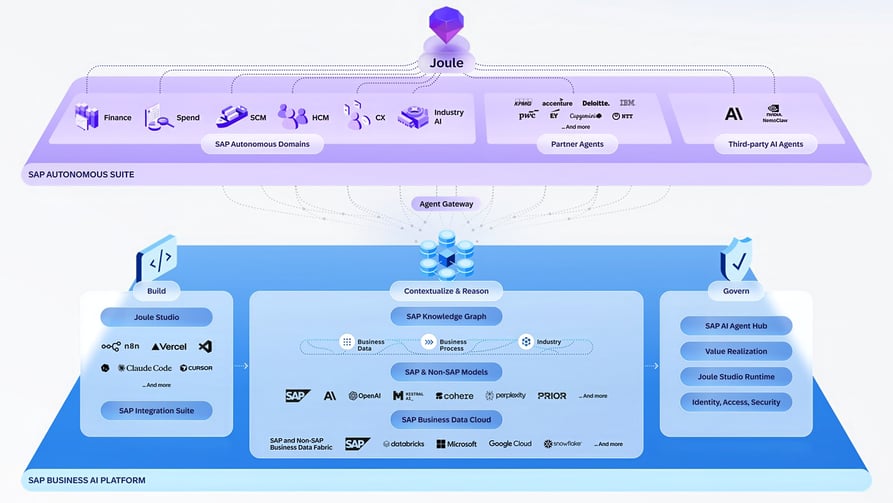
The headline here for me was the clear visual showing that SAP wants to be the fabric connecting their core ERP technologies to best-of-breed cloud giants.
© Image copyright of SAP
From the perspective of a 26-year veteran who has seen a lot of SAP technologies, the shift is this: SAP used to foster collaborative innovation with other tech firms at the platform and database layer. They were considered exceptional for the quality of their software, compatibility, and extensibility. Now they are locking those core local tech-stack areas down, closing compatibility and extensibility at that layer, and moving their Partnership focus towards cloud-focused horizontal integration, analytics, and AI. The goal of an open ecosystem remains, just in a different way.
This SAP Sapphire event in Madrid featured some excellent sessions on business process mapping and code, alongside great data products sessions, focused on business intelligence and analytics. However, data transition as a concept outside of analytics was mostly missing. Perhaps deeper technical dives are being saved for SAP TechEd; but it was refreshing to see that the previous, more forceful push towards S/4HANA upgrades has evolved into a much more collaborative and business-focused conversation. Now, the focus is less technical and far more about business transformation and finding where SAP is strongest when interacting with other technologies, while they invest in some of the best external options (such as n8n).
I came away with a very positive impression, and having Roger Federer as a speaker focused on charitable initiatives was a great way to close things out. In short, Sapphire Madrid was an excellent event.
Partner Summit sessions: Data fuelling AI, AI transforming processes
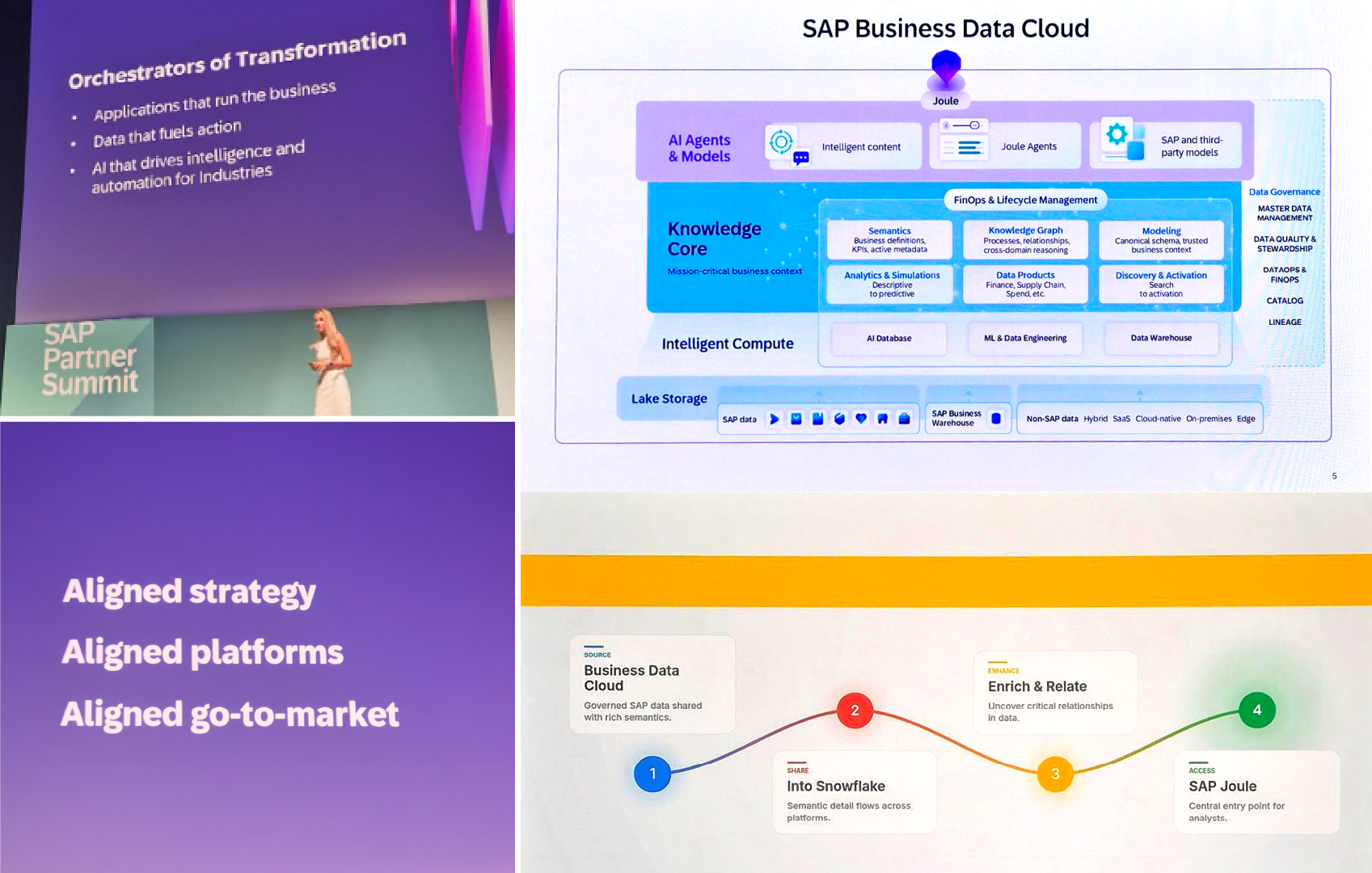
I started at the Partner Summit, watching Maddi McCrea and Mark Geall present on Partnerships with a strong focus on data fabrics and BDC. They thanked their Partners, and then focused on where things sit with AI and data: ‘Applications that run the business’ and ‘Data fuels action’.
© Images copyright of SAP
The focus was heavily on Data Fabrics and analytics feeding AI in a circular system to improve business processes: BDC > External Technologies > AI > Business Process (SAP Joule). It hits on what to do, not just what to buy. Smarter.
The images shared provide some fascinating views of how they see the SAP Autonomous Suite. It’s an interesting mix of SAP and Partner technologies all listed under SAP’s name. The fact that they show Partner and AI agents on a visual slide – almost indicating that those Partners are part of the 'SAP Autonomous Suite' – is thought-provoking. The same goes for the SAP Business AI platform; again, an SAP 'box,' but one listing a very large number of technologies from other companies.
© Images copyright of SAP
They talked openly about building for an open ecosystem. This led me to think that while SAP has locked down any open system around the platform, database, and application 'core' code, they are certainly advocating for that core to be part of a customised system in a different way, using whatever Integration, AI, and Context/Reasoning solutions suit you.
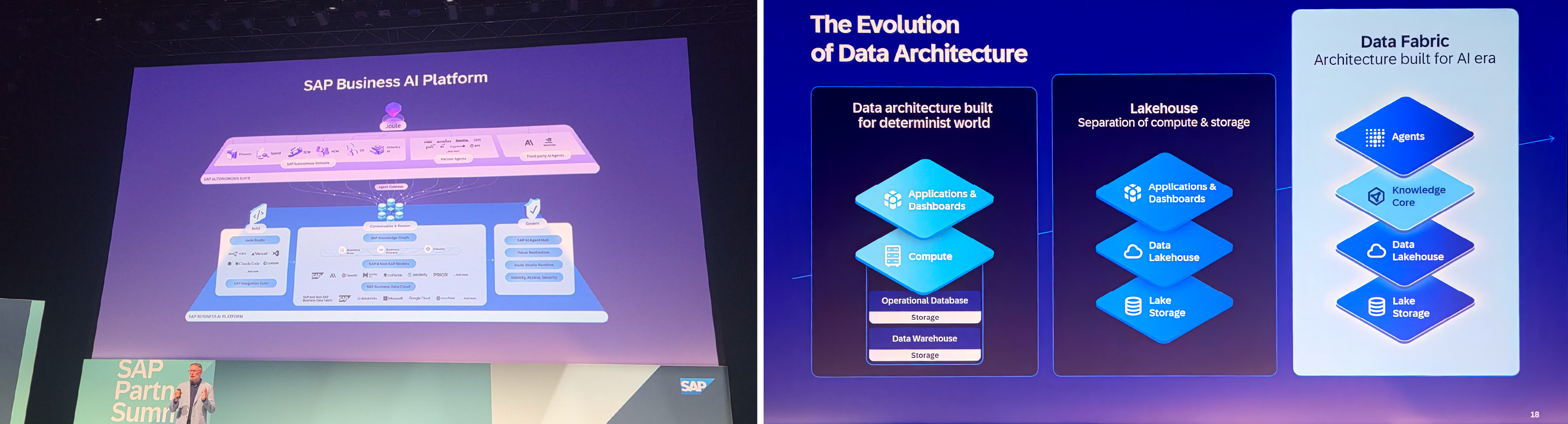
In the 1990s, we moved from mainframe to client/server. The tech stack was platform, database, and application, plus a web server as things developed. Now, cloud applications abstract and simplify these things, and the tech stack seems to be more about Applications, Data, Context, and Agents. Or, to use one SAP slide that was more data-focused: Data architecture, Lakehouse, Data Fabric.
They defined these as follows:
- Data architecture: Storage/Warehouse, Storage/Operational, Compute, Apps & Dashboards
- Lakehouse: Lake storage, Data Lakehouse, Apps & Dashboards
- Data Fabric: Lake Storage, Data Lakehouse, Knowledge Core, Agents
Aside from learning that the term 'lakehouse' is gaining serious traction at SAP (though I still have a soft spot for 'datalake'), the overarching concept is very solid: make data clearly semantically contextualised and openly available to the best technologies for analytics.
Mark Geall also talked about 'Zero copy sharing,' a term I hadn’t heard yet, so it was very interesting to find out more. It’s basically about making access to data possible without replication. This is interesting and perhaps useful language, though it also sounds akin to enabling advanced read operations. But making data products semantically aware and easily accessible? That would be excellent. Too many older cloud APIs are horribly limited or poorly documented. I guess the question most people will eventually ask is what cost is associated with the copy-sharing of data.
The seven AI Agents of the Apocalypse
Something that was oft-repeated was the seven agents of the CloudALM transformation centre. Interesting stuff, as SAP is essentially positioning its software as a project management system and adding in AI agents. CALM now has in-built agentic functionality, which is an obvious but smart move.
A demo showing agent 'Paula' working with agent 'Harry' highlighted an ambitious vision, even if the execution on stage left us wanting to see a bit more tangible output. It leaned a bit towards the narrative that a few AI agents can simply be pushed into the background to effortlessly fast-track an S/4HANA migration. As someone tinkering a lot with AI in a company rife with top-level devs pushing it to its limits, I can tell you that real-world execution is still catching up to the vision. AI is smart and has clear applications, but you cannot just throw an LLM at a complex problem and expect an instant fix. LLMs, at a basic level, are just finishing sentences based on huge datasets. Okay, it’s a bit more than this, but on some level, it’s also not!
BDC and Analytics in a bit more detail
There was quite a big SAP Business Data Cloud (BDC) focus, which is interesting as the 2040 dates for BW/4HANA will roll around before too long, meaning there’s going to be a lot of interesting transformation and data transition work there.
At EPI-USE Labs, we already have a couple of decades of experience automating BW, BW/4HANA, and native HANA data slicing. We think BW to BDC Selective Data Transitions will be big. Lots of people have huge amounts of analytics and don’t want to start from scratch, but they also don’t want to bring all that legacy data with them.
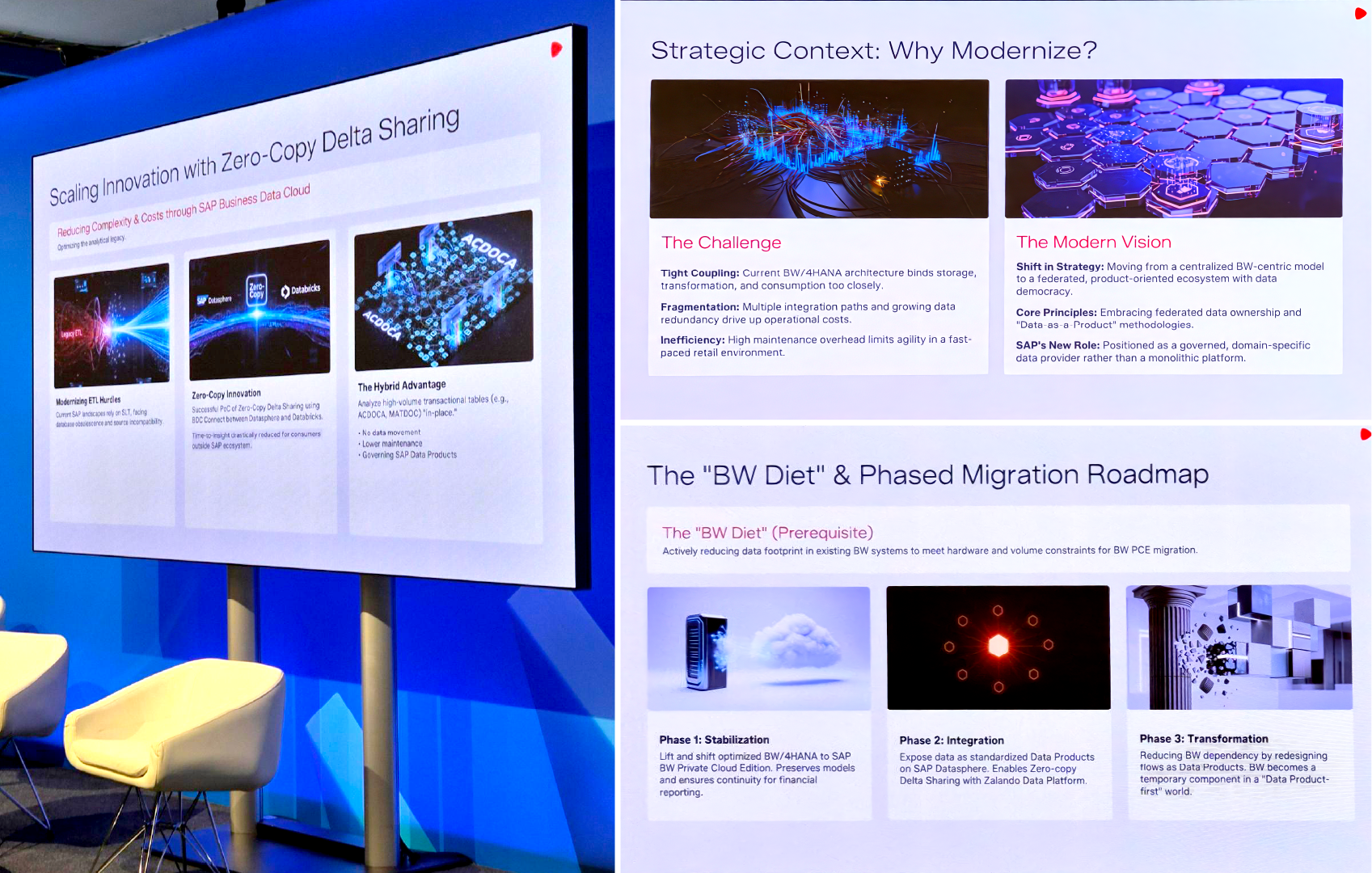
Zalando gave a great speech on modernising BW, scaling towards BDC, and slowly phasing out BW over a long period.
© Images copyright of Zalando/SAP Sapphire 2026
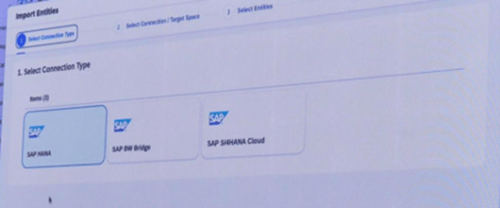
They provided a nice demo visually representing the 'Bridge' as the hopping point for SAP data transitioning to a federated, product-oriented data and analytics ecosystem.
This led into other sessions I went to, so I could see the Data Products vision.
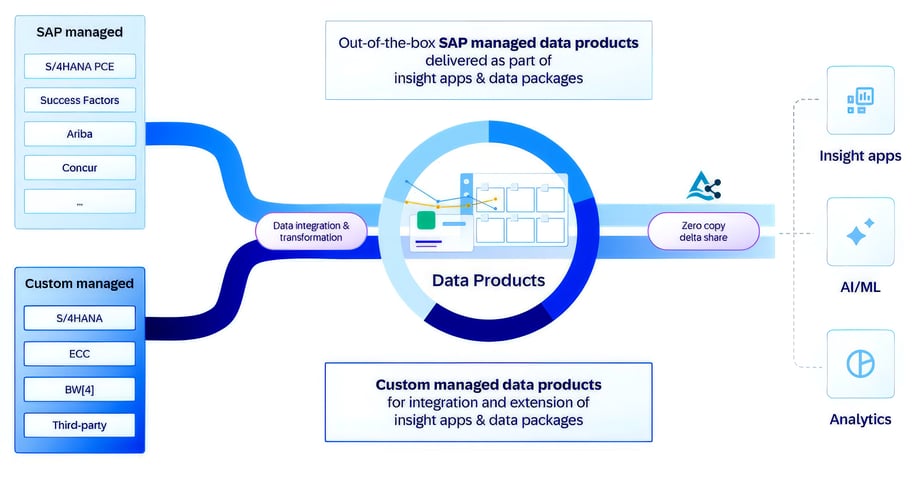
© Image copyright of SAP
This semantic handling of data is our bread and butter at EPI-USE Labs, so this was highly relevant to me. Clearly, SAP's facilitation of accessing data – either through zero-copy or replication – will be a key part of how businesses get value from their data. They highlighted Partners strongly, and as a Partner company with an entire career based on SAP, that’s great to see!
One thing you should learn this year: n8n!
Finally, I went to an n8n demo. This is a tool we use internally; I already think it’s fantastic. It’s no surprise that SAP has invested in them. A big clap to the founders and their staff; it’s a really smart piece of technology with great interfaces, backed by good training and education. If you want to tinker with how to automate any business process with AI, I highly recommend doing the n8n beginners' training.
As one of only a few European unicorn companies of the last few years, n8n is truly impressive. It also highlights a strategic shift: rather than trying to build every new innovation internally, SAP is proactively investing in and Partnering with agile external technologists. When managing a core as vast as SAP's, this collaborative ecosystem approach is a very smart move.
A shout out for Papyrus tablet delivery notes
As someone who often speaks at conferences, I feel for those needing to make IT exciting for a large audience. It’s not always easy. However, I must highlight one excellent talk from Jonathan Beardsley of OpenText, who cited Papyrus tablets as an early form of a delivery note. It was a very entertaining speech – well done, sir! His story about there also being hieroglyphic examples of customer complaints was very funny (a pre-SAP delivery note!).
.png?width=600&height=338&name=Media_(9).png)
© Image copyright of OpenText/SAP Sapphire 2026
The EPI-USE Labs team round up and ride out
Finally, with the sun shining down on the IFEMA (and the extensive, rather inconvenient roadworks for the Formula One season), I met up with two long-term associates. Between us, we have spent over 40 years with EPI-USE Labs. We donned our EPI-USE Labs / Semantik shirts, took a snap, and headed back out into 2026.
At EPI-USE Labs we help our clients (SAP integrators and direct SAP end clients) manage an application-agnostic data fabric that is semantically aware. A lot of these conferences are heavily focused on analytics data. The efficient handling of data in technical landscape processes and transformation is rarely as much of a focus. However, technical data operations are the oil that keeps things moving while businesses change, transform, and buy and sell each other.
With our software and people, we make intra- and inter-landscape operations semantically aware and smoother for clients. Data is minimised, pseudonymised, redacted, transformed, transitioned, and archived. This is what I call Lean Secure SAP. For transformation (M&A, SLO, SDT), test data operations (replicate, slice, synthesise), and data privacy operations (redact, disclose, anonymise, pseudonymise – in-place or in-flight).
Whatever you are doing, we agree with SAP: data management is crucial. Before you buy a lakehouse to put your data in, we suggest carefully architecting an agnostic semantic management layer that can efficiently handle technical data lifecycle operations.
At EPI-USE Labs, we do this with a mantra of ‘SAP-first, enterprise wide,’ and it’s great to see how well that aligns with SAP’s worldview.