
More than half of organisations running SAP are either implementing or have adopted SAP S/4HANA, yet only 34% have fully completed their transformation. This blog is a practical guide for enterprise IT leaders evaluating cloud hosting options for their SAP landscape. It covers what sets SAP workloads apart, the infrastructure requirements you should insist on, the operational expertise to look for in a provider, and the questions that will tell you more than any vendor presentation.
SUMMARY: This blog is a practical guide for enterprise IT leaders evaluating cloud hosting options for their SAP landscape. It explains what sets SAP workloads apart, the infrastructure requirements you should insist on, the operational expertise and migration methodology to look for in a provider, and the questions to ask before committing. It highlights high-memory compute, NVMe SSD storage, low-latency private networking, dedicated tenancy, backup and DR with SAP awareness, and the need for a structured assessment before migration begins.
More than half of organisations running SAP are either implementing or have already adopted SAP S/4HANA or SAP S/4HANA Cloud, yet only 34% have fully completed their transformation (SAP Insider, 2026). For many, the bottleneck is not the decision to move, but the complexity of doing it well. Choosing infrastructure that genuinely supports SAP's performance requirements; finding a provider with proven experience running complex SAP environments; and working with a team that understands how to plan, migrate and optimise SAP landscapes without introducing unnecessary risk.
This blog is a practical guide for enterprise IT leaders evaluating cloud hosting options for their SAP landscape. It covers what sets SAP workloads apart, the infrastructure requirements you should insist on, the operational expertise to look for in a provider, and the questions that will tell you more than any vendor presentation.
Why is SAP cloud hosting different?
SAP workloads, particularly those running on SAP HANA, have infrastructure requirements that generic cloud providers are not always equipped to meet. HANA's in-memory architecture requires high-memory compute nodes, NVMe SSD storage optimised for low-latency reads, and network configurations that minimise latency between application and database layers. Getting these wrong does not result in a failed deployment; it results in a slow one, with performance degradation that only becomes apparent under Production load.
Beyond infrastructure, SAP landscapes are complex interdependent systems. An S/4HANA environment typically includes Development, Quality Assurance, and Production systems, with dependencies on middleware, interfaces, and often adjacent non-SAP systems. A provider without genuine SAP experience will underestimate this complexity, and the consequences surface during migration or, worse, after go-live.
What actually matters when choosing an SAP hosting provider
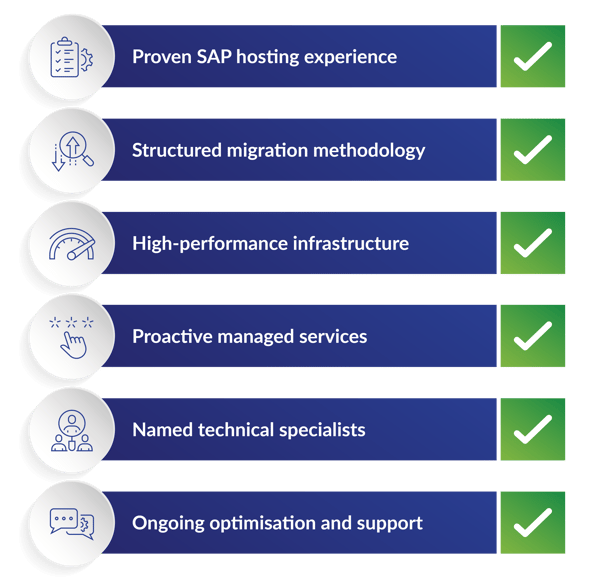
Technical capability is only one part of a successful SAP hosting environment. Equally important is the provider's operational experience, migration methodology and ability to support complex enterprise landscapes over the long term.
When evaluating providers, look beyond marketing claims and ask for evidence that they have successfully delivered environments similar to your own.
Proven SAP experience
Ask how many SAP environments the provider currently manages and whether they have experience supporting your specific SAP version, database platform and business-critical workloads. Running development systems is very different from supporting production environments that underpin day-to-day operations.
A structured migration approach
Migrating SAP requires careful planning, dependency mapping and rigorous testing. Providers should be able to explain their migration methodology, demonstrate how they minimise downtime, and describe how they manage rollback scenarios should unexpected issues arise.
Ongoing operational support
Migration is only the beginning. A strong provider should offer proactive monitoring, operating system and infrastructure management, backup and disaster recovery services, performance optimisation and regular reviews to ensure the environment continues to meet changing business requirements.
Infrastructure requirements you should insist on
Before selecting a provider for SAP HANA hosting, confirm the following:
- NVMe SSD storage
– HANA's in-memory architecture demands storage that can sustain the read/write performance of production workloads without bottlenecks. - High-memory compute
– HANA database sizes frequently run to several terabytes; confirm that compute nodes can accommodate your current size and anticipated growth. - Low-latency private networking
– latency between application and HANA layers directly impacts user experience; confirm the provider uses private networking with no public internet traversal. - Dedicated tenancy
– shared infrastructure introduces performance variability from neighbouring workloads; for production SAP systems, dedicated or appropriately isolated environments are often preferred for production SAP systems where performance consistency, security or regulatory requirements are priorities. - Backup and DR with SAP awareness
– backup schedules must account for SAP consistency requirements; not all backup tools handle SAP correctly out of the box.
Questions to ask any provider before committing
The answers to these questions will tell you more than any reference architecture diagram:
- Can you share examples of SAP environments similar to ours that you currently support, and how your team approaches migrations and ongoing operations?
- How many SAP HANA landscapes are you currently hosting in production?
- What is your migration methodology for S/4HANA, and can you walk me through a recent example?
- How do you coordinate infrastructure maintenance alongside SAP maintenance windows, and how are critical patches handled?
- What does your landscape optimisation service include, and how is rightsizing managed over time?
Common mistakes to avoid
The most common mistake enterprises make is assuming that any cloud provider can support SAP equally well. SAP landscapes have unique performance, operational and migration requirements that demand specialist knowledge and proven experience.
A close second is underinvesting in the assessment phase. The pressure to move quickly, whether driven by a VMware deadline, a contract renewal, or internal momentum, can lead organisations to skip or compress the environment assessment. This is where the most expensive surprises originate. A proper assessment of your SAP landscape, including dependency mapping and performance baselining, is not optional; it is the foundation on which a safe migration is built.
Choose your cloud hosting provider wisely!
Choosing a cloud provider for SAP workloads is not the same decision as choosing a provider for general enterprise compute. The infrastructure requirements are specific and the operational experience required is not widely distributed. The organisations that navigate this decision well are those that ask the right questions, validate a provider's technical expertise, operational capability and experience with environments like your own, while insisting on a structured assessment before migration begins. SAP in the cloud, done properly, delivers genuine operational and performance benefits. Done poorly, it creates problems that are expensive to reverse.
Explore EPI-USE Labs' iSphere Cloud solution.
FAQs
Sources
SAP Insider (2026, April 17). “2026 ERP Migration Realities: Cloud, AI, and the Looming Transition Bottleneck”. Retrieved from https://sapinsider.org/map/2026-sap-s4hana-migration-cloud-ai-bottleneck/