
Transforming PostNL's on-premise SAP Payroll to SuccessFactors ECP in the cloud

Transformation without re-implementation with PRISM: Migrating on-premise Payroll to SuccessFactors Cloud Payroll

Labs_Coloured_blocks
Play video
For large enterprises wanting to move to the cloud, deciding on your payroll approach is key. In this video, we will provide details on PRISM: a turnkey service to help you move your on-premise SAP payroll to Employee Central Payroll quickly and easily without requiring a large-scale implementation. The PRISM service is made possible through the combination of EPI-USE Labs' landscape transformation and reporting tools and EPI-USE payroll domain expertise. The PRISM service in its most basic form offers the baseline model. From there, it's a scalable model that stretches to fit a full SuccessFactors implementation project. Through this scalable model, we are able to tie in with the customer wherever they are at with their SuccessFactors journey and where they're at on the roadmap. The PRISM process consists of a number of stages from Assessment, Blueprint, Build & Test through to Go-live and Support. Let's run through these in a little more detail. In the Assessment stage, we run an automated analysis program, which introspects your current on-premise HCM system. We analyze payroll configuration, custom programs, payrun information, and history. During this process, no payroll results are extracted, only a functional and technical assessment is performed. The information collected is transformed into a graphical dashboard that provides valuable insights to customers on their SAP HCM system. This information offers customers the first opportunity to identify any areas of attention and/or clean up any unused custom objects. In the Blueprint stage, we combine the assessment results and work with you to define an overall migration plan. Our team of experienced HR and payroll consultants defines an overall scope for the project, including determining which master and transactional historical data needs to be migrated. The outcome of this stage results in an agreed blueprint. Note that it is during this phase that the team will assist you in defining how you will carve out your HCM out of your SAP ECC system, in those cases where your HR system is not on a stand-alone system. The Build & Test stage has a number of phases, the main purpose of which is to iteratively test the migration process to Employee Central Payroll based on the blueprint. The configuration and migration of employee masters to Employee Central is done via SAP provided workbooks and migration tools. Custom programs are transported into the Employee Central Payroll environment. Configuration is migrated and a subset of the payroll data - typically a historical slice - is then moved into Employee Central Payroll. Validation runs and testing are then commenced. This process will repeat itself for each of the three Employee Central Payroll instances: Development, QA, and finally Production. The first step in the migration process is to create a source system, or as we refer to it, the staging environment. As the name suggests, in this Staging phase, we create a copy of your production payroll for use in testing. We leverage the world- class SAP-certified Data Sync Manager product for this. This landscape transformation tool creates a brand new system to migrate to. All payroll data is scrambled in the staging system and source, which can then be used by the project team to test the migrated configuration and data to Employee Central Payroll. During the Build & Test of the Employee Central Payroll instance, depending on where you're at in your SuccessFactors Employee Central journey, the configuration of Employee Central or the pay components will commence. Part of this phase includes the configuration of the point to point integration, and migration of the employee data. Our certified Employee Central experts deliver the aforementioned using predefined templates and workbooks. During the Employee Central Payroll phase, the SAP Employee Central Payroll delivered instance is updated using a combination of transports for the customer-specific enhancements, and then uses our landscape migration tool to move the configuration and payroll data into the Employee Central Payroll system. It is during this phase that we surgically carve out and migrate your on-premise payroll into the Employee Central Payroll system and then provide a way to audit the payroll and the required pay run results. The Recon and Test phase consists of a number of pay runs that are undertaken on both the source and target system. Our automated reconciliation tool, Variance Monitor, is then used to identify any differences between the runs so the migration process can be tested effectively. During the Go-live stage, the production data from your on-premise HCM production system is migrated to your Employee Central Payroll production system. Validation checks are then run again, leveraging our Variance Monitor tool. After your successful Go live, you might wish to have access to your legacy SAP HCM data for reporting purposes. EPI-USE Labs optionally offers you the ability to report on data from both your legacy SAP on-premise system and your new SuccessFactors Employee Central Payroll system via user- friendly web interface, leveraging the world-class SAP-certified Query Manager with Document Builder solution. To learn more about PRISM and other creative ways that EPI-USE and EPI-USE Labs can work with you on your journey from SAP to SAP SuccessFactors in the cloud, please feel free to reach out to us at sales@labs. Epiuse. Com.

EPI-USE Labs consultants know the SAP Data model, and could advise us on the best possible strategy for migrating the data. We were able to keep all the value from our SAP Payroll while modernising our landscape. Having EPI-USE Labs help us to deliver the migration on time and within budget meant we could focus on the overall project.

Edwin van Teeffelen, SAP Project Manager

testimonial-quote
Play video
My name is Jeroen Vermeulen. I'm working for PostNL. I'm working on the move to the cloud for the SAP payroll for PostNL. We will move over payroll configuration and developments to Employee Central Cloud payroll from SAP. And combined with that, we will also move the data of all employees over to the cloud. PostNL is a company that's operating in a declining market. I need to pay special attention to every euro saved, so to say, when it comes to IT. So all the hardware is with SAP and will be maintained by SAP. What it also means is that the payroll software, it's standard and that makes it easier to maintain. The amount of data that EPI-USE Labs tools move around is quite huge compared to what we need to move, so to say. That puts it into perspective and gives some hope.


PostNL: Migrating on-premise payroll to SuccessFactors Cloud Payroll

Having made a strategic decision to move their IT landscape to the cloud, PostNL insourced their Payroll from a third-party SAP HCM Payroll in 2016. The next step was to implement SAP SuccessFactors Core HR, and finally to migrate the SAP HCM Payroll to SuccessFactors Cloud Payroll.

EPI-USE Labs implemented a migration method called PRISM which allows transformation of the SAP landscape without re-implementation. This was a major benefit to us as we were able to transform our on-premise payroll to a cloud environment without re-implementing payroll.

Edwin van Teeffelen, SAP Project Manager
testimonial-quote

The solution: EPI-USE Labs PRISM for ECP migration service

A major data migration was completed to move PostNL to SuccessFactors Cloud Payroll. This project included migrating more than 200GB of data.

Why did PostNL choose EPI-USE Labs for the migration?

PostNL chose EPI-USE Labs to execute the migration because our consultants offered:

  • A trusted relationship, and flexibility in terms of planning and execution.
  • Existing experience with PostNL environment, and data migration projects in general.
  • Intelligence in Data Sync Manager™ to execute data conversions.
  • Variance Monitor™ to automate data quality tests.

A flexible, cost-effective migration to SuccessFactors

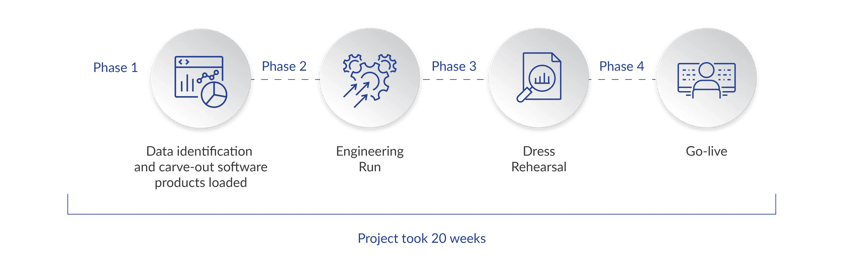
The EPI-USE Labs solution uses a combination of software and consultancy to deliver a cost-effective project. During the migration, three HR non-production clients were built to validate process and data quality before executing any runs on the ECP production system-client. EPI-USE Labs used Data Sync Manager to extract data from the current on-premise production system, and data files were moved to the SF Cloud Payroll system.
PostNL_Graphic-1

Conversions:

Part of the project included a number of conversions which needed to take place before the import to SuccessFactors. All employees with the fields position (PLANS), job title (STELL) and org unit (OREGH) in the tables PA0001 and the payroll cluster table WPBP populated with data inherited the field value 0. In addition, any employees belonging to the various departments inherited the specified personnel subarea.

Testing:

During the Engineering and Dress rehearsal phases, Variance Monitor was used to check the Payroll data for differences between the source system and target systems. All differences were highlighted by the product for investigation and resolution.

As the project developed, the team became aware of additional requirements. EPI-USE Labs was able to accommodate three change requests to successfully deliver the project.


Industry: Public Sector

Solution: PRISM Transformation, Data Sync Manager (DSM), Variance Monitor

About PostNL

PostNL is the number one service provider in mail and logistics in the Netherlands. They deliver parcels every day, and mail five days a week. On a week day, they deliver on average 1.2 million parcels and 6.3 million letters throughout the Benelux region. PostNL has the largest and most modern logistics mail and parcel network in the Benelux region. In addition, they are active throughout the world with their cross-border activities under the name of 'Spring'.

  • 32, 400 employees (one of the largest private employers in the Netherlands)
  • Active throughout the world (under Spring)
  • Approximately 5700 parcel points
  • 4.5 million users of the PostNL app
  • 25 state-of-the-art sorting centres for parcels, with over 40 robots
  • Services include delivering flowers, groceries, medicines and furniture assembly