In this blog, Daniel Mumford, a consultant who has been working with SAP for 30 years, reflects on SAP TechEd 2026, Joule, AI agents, Business Transformation Center, Selective Data Transition, and what the Autonomous Enterprise could mean for SAP consultants and transformation specialists such as EPI-USE Labs.SAP Business Transformation Center is making simpler, repeatable selective transformation increasingly productised, while complex transformations still require deep SAP expertise. Trusted data, business context, governance and experienced oversight remain critical.
SUMMARY: Daniel Mumford, an EPI-USE Labs consultant who has been working with SAP for 30 years, reflects on SAP TechEd 2026, Joule, AI agents, Business Transformation Center, Selective Data Transition, and what the Autonomous Enterprise could mean for SAP consultants and transformation specialists such as EPI-USE Labs. SAP Business Transformation Center is making simpler, repeatable selective transformation increasingly productised, while complex transformations still require deep SAP expertise. Trusted data, business context, governance and experienced oversight remain critical.
A fork in the road: What SAP TechEd 2026 means for the future of SAP consulting
After 30 years working with SAP, SAP TechEd in Berlin last month made me think back to my very first SAP implementation, and to a question I have quietly carried with me ever since.
It was SAP R/3 3.1i, and we were replacing a custom-built AS/400 solution. The existing IT team included a significant number of COBOL programmers who knew that system inside out. We needed those people. We needed their knowledge of the existing applications, data, processes and business rules so that we could understand the as-is landscape and build its replacement in SAP.
But there was an uncomfortable reality hanging over the project. We weren't simply replacing their system. The market was replacing much of their technology and, with it, the value of the specialist skills around which some of them had built their careers. Our project leadership at the time actually prepared the ‘SAP team’ for how to work sensitively with colleagues facing that situation. I spoke to some of those programmers; for some of them, it was genuinely difficult.
Companies everywhere were moving towards packaged ERP and graphical applications, and people who had spent years becoming experts in the previous generation of technology were having to decide whether and how they could reinvent themselves. I remember thinking: One day, that could be me!
My answer for the following three decades was relatively straightforward: keep learning. SAP itself gave us plenty of opportunity. Architectures changed. Products disappeared. New ones arrived. Functional capabilities expanded. Implementation approaches changed. ECC eventually gave way to S/4HANA. But at SAP TechEd Berlin 2026, for the first time in a long time, that old thought came back. Perhaps this is that moment.
This isn't just another generation of SAP
Anyone arriving at TechEd expecting another round of AI-assisted features would quickly have realised that SAP's ambition is much larger. The central idea is the Autonomous Enterprise. SAP describes Joule Work as an experience in which people describe a goal, and AI orchestrates the relevant agents, applications and data required to achieve it. Underneath that sits SAP Business AI Platform, combining business context, data, models, agent development and governance. SAP CTO Philipp Herzig characterised the direction at TechEd as moving from AI that learns your business towards AI that can run it.
That's an important distinction. This isn't merely asking Joule a question instead of searching SAP Help. The model SAP demonstrated repeatedly was closer to:
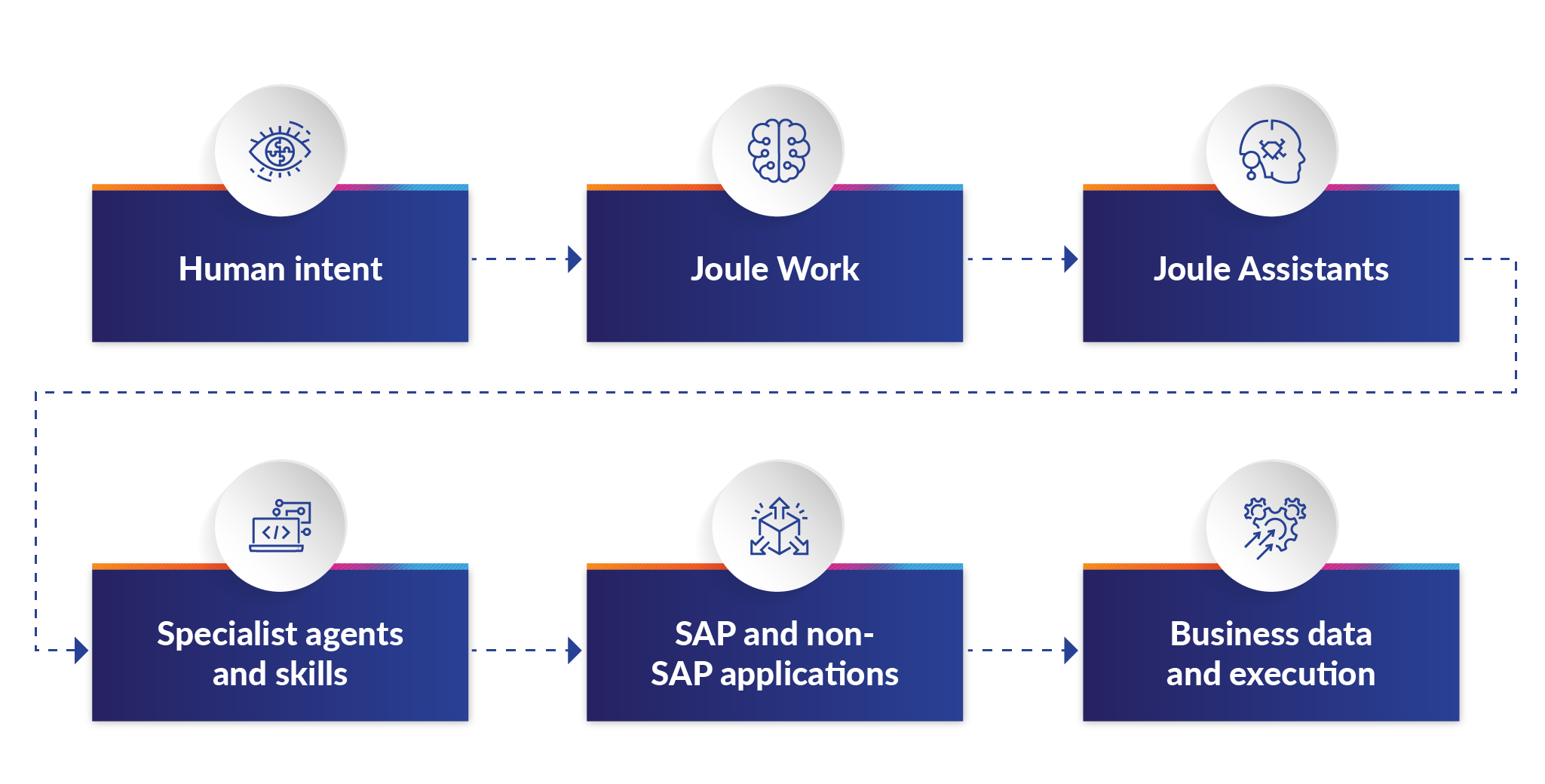
SAP says its enhanced Joule capabilities can reason, plan and execute across SAP and non-SAP systems, with governance mechanisms including permissions, auditability and human checkpoints. For someone who has spent a career translating business requirements into SAP solutions, that deserves attention: AI that actually understands SAP.
One reason this feels different is context. Generic generative AI can be impressive while knowing remarkably little about the business sitting behind the question. SAP is attempting to solve that through technologies including SAP Knowledge Graph, SAP Business Data Cloud, domain knowledge and process context. SAP describes SAP Knowledge Graph and Business Data Cloud as mechanisms for grounding agents in trusted enterprise information and giving AI richer understanding of the relationships within a customer's business.
Across TechEd, I saw this philosophy applied to development, process analysis, integration, data quality, application lifecycle management, migration and transformation. The objective increasingly appears to be: Tell the technology what you are trying to achieve, rather than manually telling it every step required to achieve it. It’s entirely conversational – like having a full SAP department of master consultants who are incredibly knowledgeable and experienced across every part of SAP, right at your fingertips, to do whatever you ask!
That has enormous potential. It also raises some uncomfortable questions.
The moment that really got my attention: SAP Business Transformation Center
For me, one of my most important sessions wasn't a futuristic AI demonstration. It was hands-on work with SAP Business Transformation Center. Selective Data Transition has historically been specialist territory. Deciding what should move, understanding organisational boundaries, historical data, financial implications, dependencies and transformation rules is not trivial.
During the workshop, I personally completed a selective transition using company-code selection and historical time slicing, together with a Chart of Accounts conversion. What impressed me was not only that the functionality existed. It was how accessible it was. The interface guided the user through assessment and scope, transformation modelling, mapping, execution preparation and validation. For the supported scenario, the experience felt deliberately designed so that the customer could make those choices without first turning the requirement into a conventional specialist consulting project. That should make anybody operating in SAP transformation sit up and take notice.
My subsequent conversation with the SAP team was equally interesting. I was told that additional predefined transformations similar to Chart of Accounts conversion are intended over time. But there is also an important boundary: the current selective capability does not go below company code, and I was told there is no current intention for it to do so. That distinction matters.
There remains a very different class of transformation involving granular organisational selection, plant-level requirements, bespoke business rules, cross-functional dependencies, customer-specific structures and complex finance and logistics interactions. Those are precisely the circumstances in which deep SAP expertise still matters. So I didn't come away thinking specialist transformation is disappearing. I did come away thinking that the simpler, repeatable end of selective transformation is becoming increasingly productised.
For companies such as EPI-USE Labs, that means differentiation has to become sharper. Being able to say “we can selectively transform SAP data” may not be enough. The value increasingly lies in solving the difficult transformations that standardised tooling cannot.
When the software starts doing the consulting
That pattern appeared beyond transformation. At TechEd, I watched AI analyse processes, propose improvements, generate development artefacts and orchestrate activity across systems. And eventually I decided to ask the question that had been bothering me. During the Q&A for a session on SAP's Process Consulting Agent, I asked what all of this means for the role of the typical SAP consultant. My question was deliberately blunt. If AI performs more of the analysis, produces recommendations and increasingly creates the solution, does the experienced consultant eventually become the person who asks the right question and validates somebody else's, or rather something else's, work? And if that's the case, what happens if analysis, investigation and solution design were the parts of consulting that person actually enjoyed?
The answers were interesting. The speakers argued that AI should make experts more powerful. It can remove repetitive work and allow experienced people to achieve far more in less time.
Another argument particularly resonated: expertise has historically been a bottleneck. There are only so many people with decades of SAP knowledge. If AI allows one experienced consultant to apply that expertise across considerably more processes and customers, AI hasn't simply replaced the expert. It has leveraged the expert. That's a compelling argument.
But one of the speakers also made what I thought was perhaps the most honest observation of the conversation: nobody really knows exactly where this settles yet. The rate of change is simply too fast. What if the boring work wasn't the bit I found boring? There is another nuance here that deserves discussion.
We often hear that AI will take away repetitive work and leave humans to concentrate on the interesting, high-value activity. I hope that's true. But after 30 years in SAP, I'm not sure technology companies and experienced consultants necessarily have the same definition of boring. Finding an obscure relationship between financial and logistics data can be interesting. Understanding why an apparently straightforward organisational change produces consequences across half a dozen functional areas can be interesting. Designing the transformation is interesting. Finding the solution to a problem nobody has solved before is interesting. Perhaps AI gives us more time for those challenges.
But if the future workflow becomes: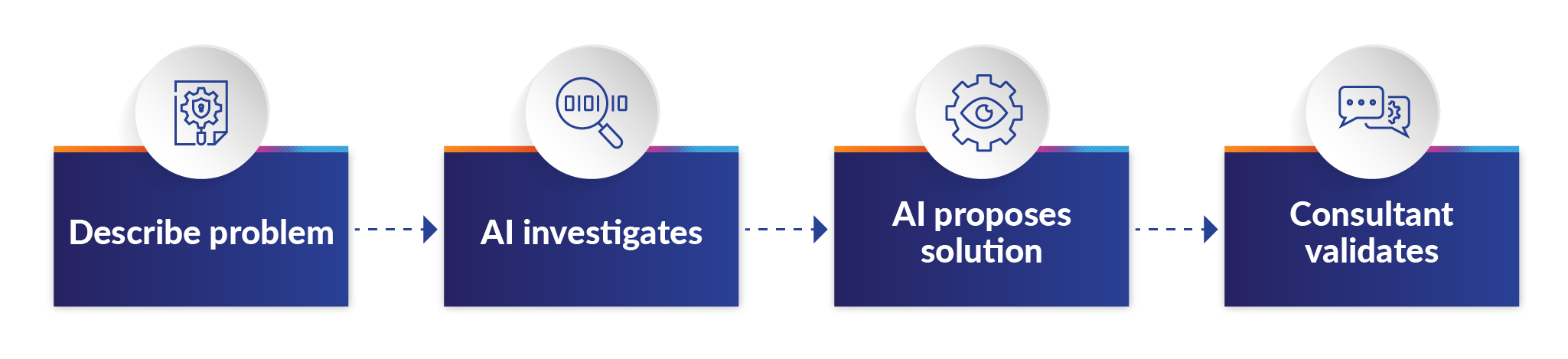
then the concern isn't simply whether the consultant still has employment. It's whether the intellectual journey that made consulting rewarding has changed with it.
The other side of the argument
There is, however, an important reason for optimism. Thirty years of SAP experience doesn't suddenly become worthless because AI knows SAP. Experience is often what tells you when an apparently sensible answer is wrong. It tells you which question hasn't been asked. It tells you that moving a plant isn't simply changing one organisational assignment. It tells you that a technically successful transformation can still create a business disaster. It provides the judgement required to understand the consequences of acting on an AI-generated recommendation. And autonomous technology may make those qualities more important, not less.
Once software stops merely recommending an action and starts executing it, trusted data, business context, governance and experienced oversight become critical. SAP's own architecture reflects this. TechEd placed considerable emphasis on role-based permissions, audit trails, human-in-the-loop checkpoints and governance of AI agents. So perhaps the consultant isn't removed from the equation. Perhaps the unit of work changes.
What could this mean for EPI-USE Labs?
There is a similar choice for technology companies operating within the SAP ecosystem. We can look at SAP's growing transformation and AI capabilities purely as competition. Some certainly are competitive. Or we can also ask a different question: What specialist intelligence will this new ecosystem need that we already possess?
EPI-USE Labs has spent decades developing deep knowledge of SAP data structures, business objects, dependencies, privacy, transformation and selective processing. An AI agent may understand that a customer wants a particular business outcome. But safely executing that outcome can require detailed knowledge of the underlying data population, relationships, dependencies and integrity rules. What if those capabilities themselves became services that agents could consume? We’re already exploring this with our Semantik solutions.
SAP's agent architecture is deliberately open. TechEd announcements highlighted support for protocols including Model Context Protocol (MCP) and Agent2Agent (A2A), enabling interaction with tools and agents beyond SAP itself.
That opens up a potentially interesting future: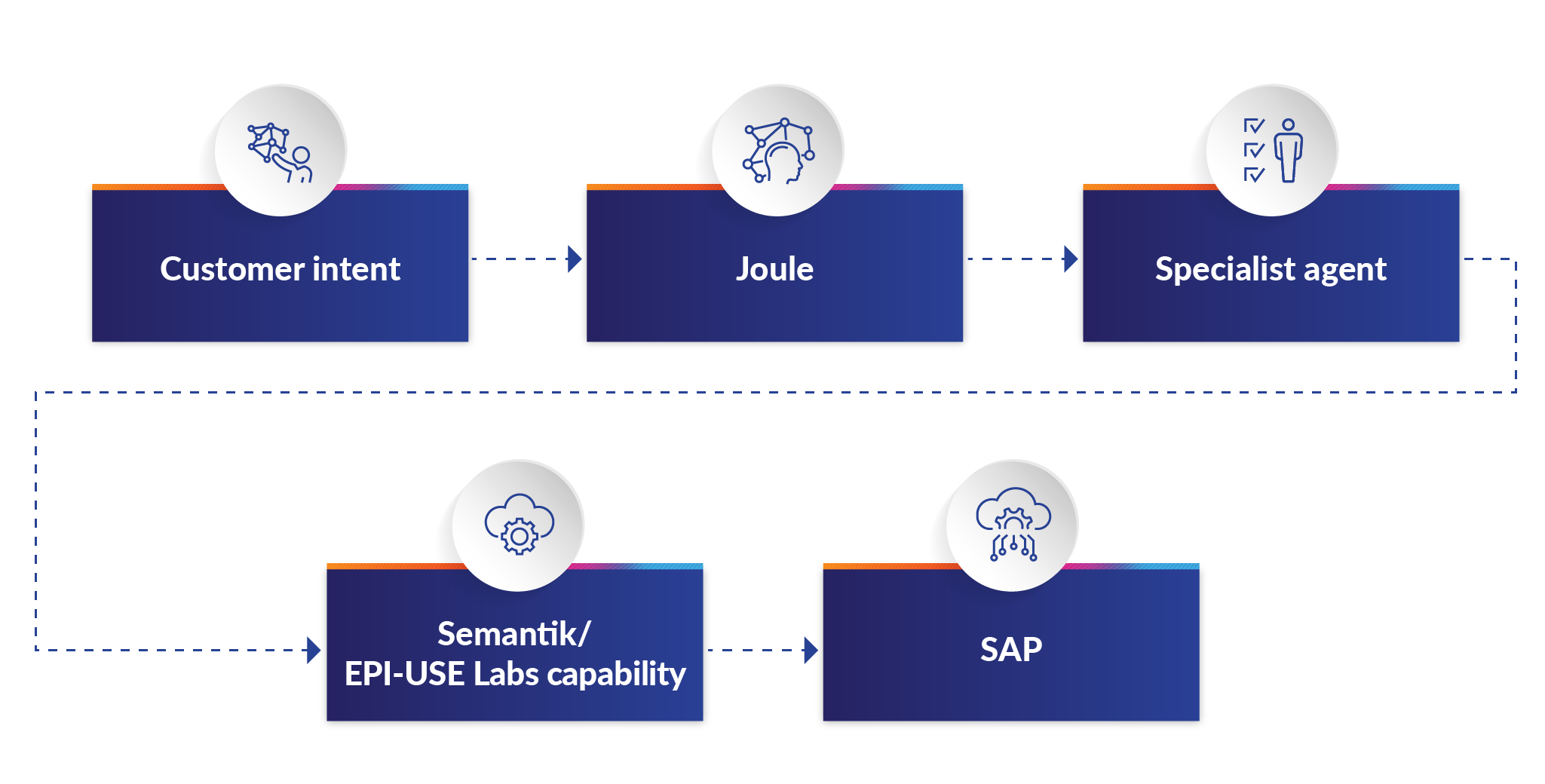
The opportunity isn't necessarily to compete with every intelligent thing SAP builds. It may be to make our own specialist intelligence increasingly automated, consumable and valuable within that world. That fits an important lesson from the history of enterprise technology. You don't protect expertise by protecting the way it has always been delivered. You protect its value by finding the next way to deliver it.
Thirty years later: another fork in the road
Which brings me back to those COBOL programmers. Thirty years ago, I watched another generation of technologists confront a change they hadn't chosen. Their expertise remained valuable to us because they understood the business and the systems we were replacing. But the technology around which they had built that expertise was changing. I wondered whether that would eventually happen to me. Perhaps I've reached that fork in the road.
I can learn this new toolset, understand how agents work, learn how to direct and govern them, and apply three decades of SAP experience through a new operating model. Or, after 30 years, I can decide that this particular technological reinvention belongs to the generation coming behind me. I don't know the answer yet. And after listening to SAP's own experts, I'm increasingly comfortable admitting that none of us knows precisely where this ends.
But I returned from Berlin convinced of something else. This isn't just another SAP upgrade. It is a change in how SAP systems are built, transformed and operated, how expertise is captured and applied, and potentially what it means to be an SAP consultant.
At the start of my SAP career, I was part of the generation implementing the technology that would replace what came before. I may now be standing on the other side of that transition; but I've spent 30 years learning SAP, and I think I can still teach AI a thing or two!