
Blog 4 in series: In this blog, the fourth in the series on navigating the path to SAP S/4HANA, we look at choosing between RISE with SAP for S/4HANA Cloud Private Edition, and GROW with SAP for S/4HANA Cloud Public Edition. This is not just about selecting a software version; it is about defining your operational model for the next decade. We compare deployment models, licensing, custom code, the Partner role, and the Shared Responsibility Model, and highlights core phases for a successful migration.
Blog 4 in S/4HANA navigation series
SUMMARY: This blog, the fourth in the series, outlines the defining decision in an SAP S/4HANA migration: choosing between RISE with SAP for S/4HANA Cloud Private Edition, and GROW with SAP for S/4HANA Cloud Public Edition. It compares deployment models, licensing, custom code, the Partner role, and the Shared Responsibility Model, and highlights four core phases for a successful migration: Discovery & Strategy, Preparation, Design & Plan, Build & Validate, and Deploy & Operate.
Welcome to the fourth blog in our series on navigating the path to SAP S/4HANA. In Blog 1 and Blog 2, we explored the strategic case for the move, and the preparation required to get there. Blog 3 focuses on hosting S/4HANA yourself; and this blog looks at SAP’s own cloud routes – RISE with SAP and GROW with SAP.
What do the 2030 and 2040 deadlines mean?
SAP is ending mainstream maintenance for its legacy ERP system (SAP ECC) on 31 December 2027. Extended maintenance is available until 31 December 2030.
SAP has publicly committed to maintaining and supporting S/4HANA until at least December 31, 2040 — guaranteeing the core architecture will remain relevant for well over a decade.
Two paths, one decision
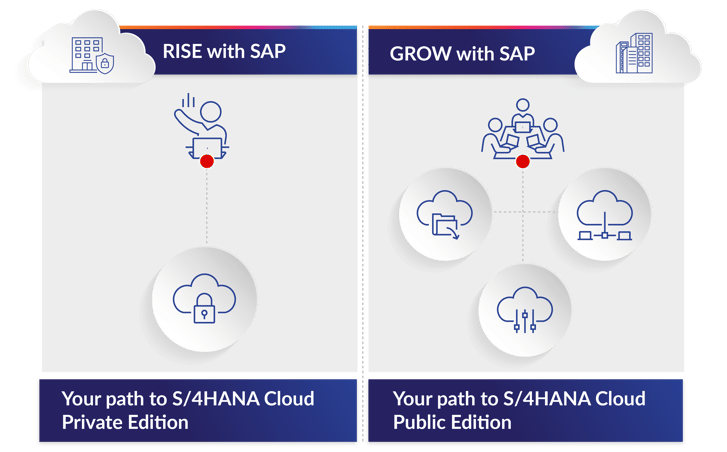
SAP has simplified its cloud portfolio into two primary offerings: RISE with SAP and GROW with SAP. Choosing between them is not just about selecting a software version; it is about defining your operational model for the next decade. The core difference comes down to the deployment model: RISE is your path to S/4HANA Cloud Private Edition, while GROW is exclusively your path to S/4HANA Cloud Public Edition.
Licensing implications
Migrating via RISE with SAP or GROW with SAP fundamentally changes your software licensing from a capital asset model to an operational expense model:
- Full Usage Equivalents (FUE): Licensing shifts from static named users to a weight-based metric that allows dynamic license allocation.
- Bundled subscription: The software license, maintenance contract, database, and cloud infrastructure are consolidated into a single subscription fee – reducing vendor flexibility.
- Legacy licence impact: Any investment in unused perpetual licenses is lost, though some discounts may be negotiated.
SAP Cloud Private Edition
Best for: Existing SAP ECC customers or large enterprises with complex, highly customised systems requiring deeper control over data and processes.
SAP positions RISE as "Business Transformation as a Service." It is designed to help you move your legacy footprint to the cloud without starting from zero — modernising systems while preserving the custom code and programs that make your business unique.
- Dedicated Private Cloud: Operated in a dedicated instance on the hyperscaler of your choice, offering some of the application flexibility of an on-premise system with full ABAP access and source code modifications. SAP prefers a clean-core approach, but does not enforce it.
- Controlled upgrades: You or your partner control the timing of patching and upgrades.
- Bundled pricing: RISE operates as a single subscription contract with SAP. Pricing is highly tailored based on infrastructure requirements and functional scope.
- Flexible migration: Supports Greenfield (new implementation), Brownfield (system conversion), and Bluefield (selective data transition).
What about custom code in SAP Cloud Private Edition?
S/4HANA introduces a simplified data model that consolidates multiple legacy financial tables into the single Universal Journal (ACDOCA). Your existing code must be adapted to function within this new architecture:
- Code remediation: Manually update or rewrite incompatible ABAP code to utilise new tables and structures.
- Code retirement: Unused code – identified via tools like SUSG or UPL – is typically deleted.
- Field length extensions: Changes such as the Material Number field increasing from 18 to 40 characters require code adjustments to prevent data truncation errors.
The Partner role in SAP Cloud Private Edition
While the RISE offering provides the cloud framework, your integration partner executes the technical heavy lifting.
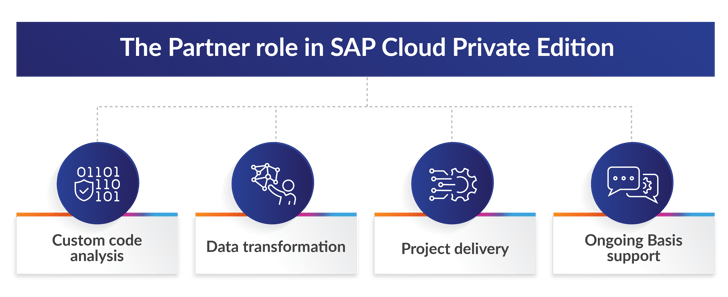
Core responsibilities include:
- Custom code analysis: Analyse your legacy system's custom ABAP code (Z-programs) and determine what to rewrite, adapt, or retire.
- Data transformation: Transform existing historical data, ensuring years of financial and operational records map accurately to the new system.
- Project delivery: Direct project execution, control technical downtime windows, and coordinate stakeholder communication throughout the migration.
- Ongoing Basis support: Basis support is still required from the application layer upward, including upgrade and maintenance projects. Find out how our BRIDGE Managed Services can help you in this scenario.
SAP Cloud Private Edition: Lessons from the field
- Preconfigured lead times in SAP's ticketing system frequently delay technical task routing by multiple days. Plan accordingly.
- Basis support is only included up to the infrastructure layer. In-house Basis teams or external partners are required for everything above.
- Third-party applications or agents are generally not supported on the SAP or operating system layer.
- While costing is simpler under one subscription bundle, it is not necessarily cheaper than on-premise.
SAP Cloud Public Edition
Best for: Mid-market companies or net-new SAP customers who want a clean start with a standardised, modern ERP – without the desire for heavy customisation.
GROW with SAP enforces standardised best practices. Your business adapts its processes to the software, not the other way around.
- Fully-managed Public Cloud: Operated entirely by SAP. Customisation is highly restricted and core code remains untouched.
- Mandatory auto-upgrades: Upgrades are automated and pushed by SAP frequently, ensuring you are always running the latest innovation.
- Simplified pricing: A straightforward subscription model based on users, covering software, standard infrastructure, and core services.
- Greenfield only: You start with a clean slate and bring over only essential master and open transactional data.
What about custom code in SAP Cloud Public Edition?
- Legacy code abandoned: Custom ABAP code is not moved into a public cloud environment. The business must adopt standard SAP processes to replace the functionality previously handled by custom code.
- BTP for critical gaps: If a critical custom process cannot be met by standard functionality, the logic is built from scratch as a separate application hosted on SAP Business Technology Platform (BTP).
The Partner role in SAP Cloud Public Edition
In a Public Cloud implementation, your partner acts less like a developer and more like a business consultant and change agent.
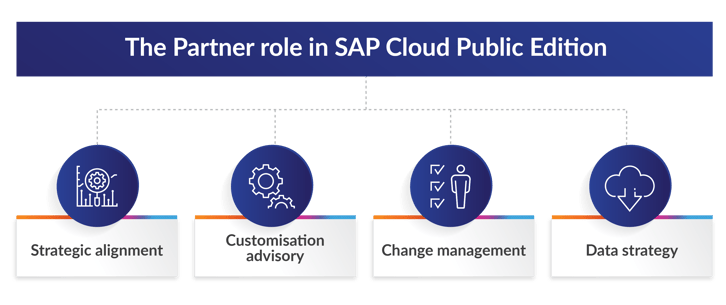
- Strategic alignment: Present SAP's pre-configured best practices and guide your teams on adapting existing business processes to fit out-of-the-box workflows.
- Customisation advisory: Solve operational challenges using standard functionality or leverage SAP BTP for necessary side-by-side extensions, keeping the core ERP clean.
- Change management: Drive user training, stakeholder communication, and smooth transition to the new way of working.
- Data strategy: Guide the extraction of legacy data, enforce external cleansing, and manage the upload into the new public cloud environment using standard SAP migration templates.
Lessons learned from real-world migrations
We have learned important lessons from migrations for our clients around the world.
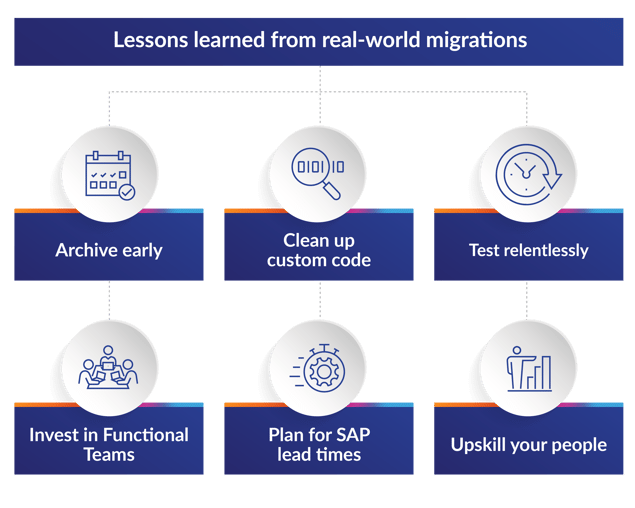
- Archive early: Execute data archiving before migration to reduce the data footprint — lowering both cost and complexity.
- Clean up custom code: Leverage BTP where possible to replace legacy customisations.
- Test relentlessly: Deep integration testing and UAT is critical throughout the process.
- Invest in Functional Teams: Strong functional teams are just as important — if not more so — than the technical migration team.
- Plan for SAP lead times: Time management is more important than ever. Factor in the new lead times when logging tickets with SAP RISE.
- Upskill your people: Teams need to transition from legacy Basis administration to cloud architecture and BTP development.
The Shared Responsibility Model
The biggest mistake companies make is assuming that moving to the cloud means SAP handles everything. SAP operates on a strict Shared Responsibility Model. While SAP takes over low-level infrastructure tasks, your internal team and your partner retain full accountability for how the application actually serves your business.
| Area | SAP Responsibility | SAP Customer / Partner Responsibility |
|---|---|---|
| Infrastructure | Operates and manages hyperscaler infrastructure and SAP-managed cloud environment | Not applicable |
| OS & Database | Performs installation, maintenance, and technical patching of OS and SAP HANA database | Assess, request, and validate patches in line with change management procedures |
| Application Patching | Delivers selected mandatory or critical SAP Notes | Assess, plan, request, and test all application-level patches and SPs |
| Application Configuration | Provides standard SAP-delivered system ("fit-to-standard" baseline) | Configure, harden, and secure the application per business and compliance requirements |
| Identity & Access Management | Delivers initial technical users and standard roles | End-to-end user lifecycle management, role design, authorisations, and SoD controls |
| Custom Code & Extensions | Not responsible for customer-developed objects | Full responsibility for ABAP, BTP extensions, security, performance, and compliance |
| Interfaces & Integrations | Secure SAP-managed technical endpoints and communication channels | Secure and operate customer-managed integrations, including third-party systems, APIs, RFC connections, and middleware |
| Data Protection & Classification | Provide platform-level security controls, including infrastructure encryption and access protection | Define data classification, manage encryption usage, and ensure protection, retention, and lawful processing of business data |
| Security Monitoring | Monitor SAP-managed infrastructure and platform components for security events | Perform application-level monitoring, logging, and detection of suspicious or unauthorised activity |
| Audit & Compliance | Provide infrastructure and platform audit reports, e.g., SOC | Implement application-level controls, prepare audit evidence, and ensure regulatory compliance, e.g., SOX, GDPR |
How is my ROI affected?
- CapEx to OpEx: Replace heavy hardware capital expenditures with a predictable, operational cloud subscription.
- Legacy risk: Retaining SAP ECC past the 2030 support deadline creates severe financial, security, and operational liabilities.
Navigating your endpoint: Your journey, your choice
Selecting your S/4HANA endpoint is a strategic decision that defines your future operating model — and fundamentally shifts how your integration partner operates.
RISE with SAP is designed for enterprises whose competitive edge relies on highly specialised, differentiated processes. It offers flexible upgrade paths and full developer access, providing the controlled framework necessary to migrate complex legacy systems on your own terms.
GROW with SAP is your rapid deployment option. Designed for fast adoption of standardised industry best practices, it features simplified subscription pricing, fully managed infrastructure, and mandatory auto-upgrades to keep your core perpetually modern.
| Feature | SAP Cloud Private | SAP Cloud Public |
|---|---|---|
| Main endpoint | S/4HANA Cloud Private Edition | S/4HANA Cloud Public Edition |
| Primary audience | Large enterprises, existing SAP installed base | Mid-market, net-new SAP customers |
| Migration path | System Conversion (Brownfield) and new implementation (Greenfield) | Greenfield (new implementation) only |
| Customisation level | High, like on-premise, full ABAP access; Clean Core advised but not enforced | Low, focus on best practices, BTP extensions |
| Upgrades | Controlled by client, flexibility | Mandatory and automated, SAP controlled |
| Pricing model | Bundled, subscription based on complex scope | Simplified, subscription based on users |
Ultimately, whether you choose RISE with SAP to transition complex operations or GROW with SAP to shed technical debt, the work does not end at go-live. A robust support framework – whether driven by an ongoing partner relationship or a dedicated internal team – remains an absolute necessity to sustain and optimise your new cloud environment.
Migration at a glance: Four core phases
Regardless of the chosen cloud endpoint, executing these four core phases is essential for a successful migration:
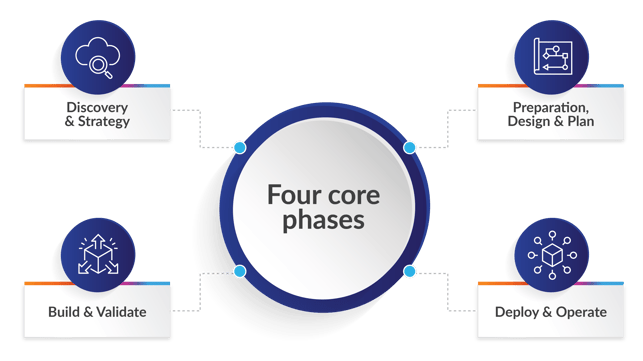
- Discovery & Strategy: Define the strategic scope, evaluate existing technical debt, and select the optimal cloud endpoint.
- Preparation, Design & Plan: Cleanse historical data, execute fit-to-standard workshops, and provision the initial sandbox environment.
- Build & Validate: Configure the core system, develop necessary BTP extensions, and validate functionality through rigorous user acceptance testing.
- Deploy & Operate: Execute the final data cutover, activate the production environment, and transition to the ongoing support model.
Explore the rest of the blog series
This is Blog 4 in a multi-part series on navigating the path to S/4HANA. Explore the rest of the series:
Blog 1: S/4HANA navigation path: How to chart your course
Blog 2: S/4HANA navigation path: How to prepare for lift-off
Blog 3: S/4HANA navigation path: On-premises endpoints and hyperscaler hosting
Blog 5: S/4HANA navigation path: AI integration
Blog 6: S/4HANA navigation path: SAP Cloud project support during and post go-live
Blog 7: S/4HANA navigation path: Standard project support during and post go-live