
Blog 1 in series: The SAP landscape is evolving at breakneck speed. This blog, the first in the series, provides a high-level roadmap for evaluating your SAP strategy: optimising ECC, or transitioning to S/4HANA. It outlines the strategic value of modernising with S/4HANA, options to optimise your current landscape without leaving ECC, and data-driven guidance using EPI-USE Labs' Enterprise Navigation Strategy.This multi-part blog series cuts through the vendor noise to help tech-curious leaders understand their true options and chart a clear course to SAP S/4HANA.
Blog 1 in S/4HANA navigation series
SUMMARY: This blog, the first in a series, provides a high-level roadmap for evaluating your SAP strategy: optimising ECC, or transitioning to S/4HANA. It outlines the strategic value of modernising with S/4HANA, options to optimise your current landscape without leaving ECC, and data-driven guidance using EPI-USE Labs' Enterprise Navigation Strategy. It also explains the architectural endpoints and technical migration paths: SAP-managed SaaS or self-hosted private cloud, and Greenfield, Brownfield, or IP-driven data migration.
The SAP landscape is evolving at breakneck speed. Between looming end-of-life deadlines for legacy systems and a constant influx of new technological capabilities, separating the ‘must-haves’ from the ‘nice-to-haves’ is difficult. This multi-part blog series cuts through the vendor noise to help tech-curious leaders understand their true options and chart a clear course to SAP S/4HANA.
The first blog in this series provides a high-level roadmap for evaluating if S/4HANA is the right foundation for your enterprise, how to get there, and the essential tools for the journey.
Evaluating your SAP strategy: Optimising ECC, or transitioning to S/4HANA?
Many organisations operate on legacy SAP ECC systems that are rapidly approaching the end of mainstream maintenance in 2027. However, a full migration to S/4HANA is not the only path forward. As your technical partner, our goal is to evaluate your unique landscape and help you make a final decision that perfectly aligns with your business requirements – whether that means optimising your current SAP ECC environment, or moving to a new platform.
There are myriad technical pathways and options available, depending on your goals:
Option 1: Modernising with S/4HANA (on-premises S/4HANA, versus SAP Cloud Private Edition, versus SAP Cloud Public Edition)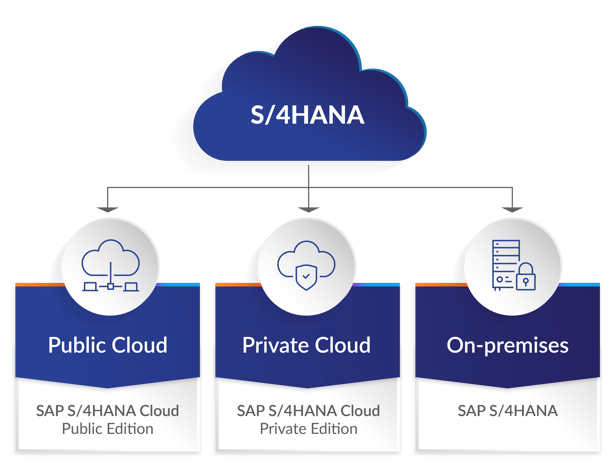
If our joint assessment reveals that an upgrade is the right strategic move, transitioning to S/4HANA is a proactive strategy to turn your SAP ERP from a system of record into a system of intelligence. This is what makes the move strategically worthwhile:
- Real-time business operations: Migrating to the in-memory SAP HANA database eliminates batch processing, allowing leaders to make decisions based on live, up-to-the-second operational data.
- Next-Generation AI integration: S/4HANA natively supports advanced AI. Whether leveraging SAP's own generative AI assistant to streamline operations, or integrating with external tools, the platform automates the mundane and elevates human decision-making.
- Escaping the legacy trap: You leave behind restrictive architectures for a modernised environment designed for continuous evolution.
More context on each of these endpoints will be covered in more detail in later blogs within this series.
Option 2: Optimising your current landscape
If a full system conversion does not currently align with your business goals, there are significant ways to optimise performance and reduce risk, without leaving ECC:
- System and data clean-up: We can streamline your existing environment by removing or archiving old data to reduce hardware storage costs and lower compliance risks. We can also revitalise your system by using tools like the SAP Code Inspector (SCI) and ABAP Test Cockpit (ATC) to identify and remove outdated or unused custom ABAP code.
- Business Suite on HANA (BSOH): If you want database modernisation without a full application overhaul, we can migrate your current non-HANA database to SAP HANA while staying on ECC. This introduces modern architecture benefits with far less business process impact than a full S/4HANA conversion.
- Infrastructure refresh and right-sizing: Ageing on-premises hardware is often over-provisioned or running beyond its supported lifecycle, driving unnecessary cost and risks. Refreshing or right-sizing your infrastructure – whether staying on-premises or moving to a hosted environment – can significantly reduce hardware maintenance costs, improve system performance, and eliminate the vulnerability of running on unsupported equipment.
- Virtualisation and consolidation: Where multiple physical servers are running underutilised workloads, virtualising your SAP landscape allows you to consolidate onto fewer, more efficient hosts. This reduces your physical footprint, lowers energy and licensing costs, and makes your environment easier to manage and scale.
- Hybrid cloud adoption: Rather than an all-or-nothing approach to the cloud, a hybrid model allows you to selectively move non-production systems (development, QA, training) to the cloud while keeping production on-premises. This reduces the cost of maintaining development infrastructure in-house, and gives you the flexibility to scale environments up or down on demand – without the risk of a full Production migration.
- Managed Services Transition (OPEX Model): Shifting from owning and managing your own SAP infrastructure (CAPEX) to consuming it as a managed service (OPEX) reduces the burden on your internal IT team and converts unpredictable capital expenditure into a predictable monthly cost. This is particularly valuable for organisations where the Basis team is stretched thin, or where hardware refresh cycles create irregular budget spikes.
- Non-production system optimisation: Non-production landscapes (development, test, and sandbox systems) are frequently bloated copies of Production, consuming disproportionate storage and compute resources. Using tools like EPI-USE Labs' Data Sync Manager, these systems can be refreshed with a lean, masked subset of Production data – dramatically reducing their footprint and the cost of running them, while also improving data privacy compliance.
Make a data-driven decision
To help guide this final decision, with our Enterprise Navigation Strategy we can perform a detailed analysis to gain comprehensive insights into your existing system. By extracting quantitative metadata – without exposing actual client data – we can analyse the potential impact on your business processes and custom code, ensuring the path we choose is the absolute best fit for your organisation.
How do you get to S/4HANA? Endpoints and migration paths
Getting to S/4HANA requires two major decisions: choosing who holds the keys to your system (the endpoint) and how you move your data (the migration path).
1. The architectural endpoints
- SAP-managed SaaS (Private/Public Cloud): A standardised, vendor-managed subscription. SAP provides the software, handles the infrastructure, and enforces regular, mandatory upgrades. It is fast to deploy, but requires you to adapt your business processes to fit the standard software.
- The self-hosted private cloud: The path of ultimate sovereignty. You purchase software licences and deploy S/4HANA on your own dedicated infrastructure (AWS, Azure, Google Cloud, or an internal data centre). You retain total control over data residency, deep system customisation, and the timing of your upgrade roadmap.
2. The technical migration paths
- Greenfield (new implementation): A fresh start, leaving legacy code behind. This is mandatory if moving to a standardised SaaS environment.
- Brownfield (system conversion): The ‘lift and shift’ approach. You convert your existing ECC system directly into S/4HANA, taking historical data and workflows with you (highly suited for the self-hosted private cloud).
- IP-driven data migration (Selective Data Transition): A hybrid model migrating only specific historical data and vital workflows, leaving obsolete junk behind. Read more in this blog.
| Migration Path | Pros | Cons |
|---|---|---|
| Greenfield | Leaves restrictive legacy architectures behind. Mandatory for highly standardised, multi-tenant SaaS environments. Allows adoption of out-of-the-box best practices. | Transactional data usually remains in a separate read-only environment. Requires significant change management and training. Core configurations and roles must be rebuilt from the ground up. |
| Brownfield | Business continuity focus – seamlessly upgrades your legacy application and database in place. Can be decoupled by migrating to a HANA database first (Business Suite on HANA) to minimise process impact. Excellent for retaining custom workflows in a private cloud. | The source system must be on ECC 6.0, fully Unicode enabled, and split into an ABAP-only stack. Requires heavy remediation of custom ABAP code using tools like SAP Code Inspector (SCI) and ABAP Test Cockpit (ATC). HANA's in-memory architecture requires rigorous data archiving first to avoid high storage costs. |
| IP-driven data migration | Avoids an all-or-nothing system conversion. Selectively migrates vital workflows while leaving obsolete junk behind. Significantly reduces target system memory footprint and costs. | Slicing out specific organisational entities requires specialised third-party software, which EPI-USE Labs can provide. Extensive data modelling and mapping make it highly complex without the right partner. High risk of broken links between historical and master data if executed poorly. EPI-USE Labs PRISM for S/4HANA solution is a flexible approach to create a lean, secure SAP estate. |
Explore the rest of the blog series
This is Blog 1 in a multi-part series on navigating the path to S/4HANA. Read the rest of the series:
Blog 2: S/4HANA navigation path: How to prepare for lift-off
Blog 3: S/4HANA navigation path: On-premises endpoints and hyperscaler hosting
Blog 4: S/4HANA navigation path: What's the difference between SAP S/4HANA Cloud Private and Public Editions?
Blog 5: S/4HANA navigation path: AI integration
Blog 6: S/4HANA navigation path: SAP Cloud project support during and post go-live
Blog 7: S/4HANA navigation path: Standard project support during and post go-live