
When SAP teams think about sensitive data, they think of Production systems. But when you look closely at real SAP landscapes, the bigger risk increasingly sits somewhere else. DEV, QA/SIT, UAT, PRE-PROD, training, sandboxes, project systems – all of these non-production systems contain replicated Production data, usually copied to ‘keep testing realistic.’ Over time, these environments expand, accumulate integrations, and grant access to offshore testers, partners, developers, and contractors. Meanwhile, patching is slower, monitoring is lighter, and controls are rarely as strict as Production.
When SAP teams think about sensitive data, they think of Production systems. But when you look closely at real SAP landscapes, the bigger risk increasingly sits somewhere else.
DEV, QA/SIT, UAT, PRE-PROD, training, sandboxes, project systems – all of these non-production systems contain replicated Production data, usually copied to ‘keep testing realistic.’
Over time, these environments expand, accumulate integrations, and grant access to offshore testers, partners, developers, and contractors. Meanwhile, patching is slower, monitoring is lighter, and controls are rarely as strict as Production.
For SAP customers preparing for S/4HANA, modernising SAP Payroll, integrating SAP SuccessFactors, or running ongoing change cycles, this gap has become one of the most significant – and least discussed – data privacy and security risks.
This article explains why SAP non-production environments are increasingly under scrutiny, what regulators expect now, and how SAP customers can reduce risk without slowing down delivery.
Why are SAP systems actively targeted by attackers?
Attackers increasingly understand SAP’s architecture. Over recent years, the National Vulnerability Database (NVD) has published multiple critical vulnerabilities across SAP NetWeaver and SAP S/4HANA, including:
- CVE-2020-6287 (“RECON”) – unauthenticated remote code execution in SAP NetWeaver Application Server
- CVE-2022-22536 – a request-smuggling flaw affecting SAP NetWeaver and SAP S/4HANA
- CVE-2019-0194 (10KBLAZE-related) – enabling privilege escalation under specific SAP NetWeaver configurations
- CVE-2021-27610 – an SAP NetWeaver Application Server Java vulnerability allowing unauthorised access
Two realities stand out:
- SAP applications are actively researched and targeted.
- Uneven patching – especially in non-production – creates real exposure.
These disclosures underscore the need for timely patching and consistent security controls across the SAP landscape. While Production environments typically respond quickly to new vulnerabilities, non-production systems – often perceived as lower risk – are patched more slowly or inconsistently.
Because these environments hold the same sensitive data as Production, this disparity in patching cadence introduces an avoidable and often underestimated source of risk.
Why is real personal data in test environments high-risk? Global regulators are clear:
Across the globe, regulators increasingly warn against using real personal data in testing unless organisations can demonstrate a lawful basis, strict controls, and genuine data minimisation.
Australia
Under the Australian Privacy Principles (APPs):
- APP 6 limits secondary use of personal data (testing is not a permitted purpose for HR, finance, or payroll information).
- APP 11 requires organisations to secure personal information in every environment.
European Union (General Data Protection Regulation, GDPR)
GDPR requires:
- purpose limitation
- data minimisation
- privacy by design and default
- equivalent protection for replicated datasets
Japan
Test environments using Japanese personal data should apply irreversible anonymisation to avoid falling under APPI requirements.
New Zealand
The Office of the Privacy Commissioner’s case note “Testing systems with real data leads to breach” advises organisations not to use identifiable personal data in non-production environments.
Saudi Arabia
Saudi Arabia’s PDPL (Personal Data Protection Law) is explicit on anonymisation. Regulations require that anonymised data must be irreversibly unidentifiable, making re-identification impossible. Data that meets this standard is no longer considered personal data under the PDPL and falls outside its scope:
For test environments, this means partial masking or scrambling is not enough if re-identification remains technically possible.
Singapore
The Personal Data Protection Commission (PDPC) recommends anonymising or pseudonymising test data wherever possible and restricting access.
South Africa
POPIA (Protection of Personal Information Act) requires organisations to take appropriate technical measures to prevent identification where personal data is no longer needed for its original purpose. While POPIA does not remove anonymised data from scope as explicitly as other privacy laws, it strongly supports de-identification and anonymisation for testing to meet data minimisation and security safeguards.
If data in test systems can still reasonably be re-identified, POPIA obligations continue to apply.
Across jurisdictions, the message is the same:
If personal data is copied into non-production, it must be protected to the same standard as Production.
For SAP customers, meeting this standard is challenging due to the scale and integration of their landscapes. As such, most SAP landscapes do not meet this threshold today.
What does SAP’s DPP guidance state?
SAP’s Data Protection and Privacy (DPP) guidance mirrors regulatory expectations. SAP recommends minimising personal data in non-Production environments, applying masking or pseudonymisation, enforcing least-privilege access, and adopting privacy-by-default across SAP programmes.
In essence, SAP and regulators are aligned: non-production data must be controlled, masked, and governed.
The challenge lies in execution across large, integrated landscapes.
What steps can you take to reduce non-production data risk?
To meet regulatory expectations and reduce non-production risk, organisations require four foundational capabilities:
- Controlled data subsetting to limit how much personal data enters non-production
- Consistent masking or anonymisation of personal, sensitive, financial, and payroll data
- Governed refresh pipelines that ensure all environments receive protected data
- Audit-ready evidence that proves compliance across SAP and downstream systems
These capabilities form the backbone of modern SAP test-data privacy.
Why is this so hard in the world of SAP?
These capability gaps become most visible during large SAP transformation or modernisation initiatives. S/4HANA migrations, SAP Payroll and SAP Employee Central Payroll implementations, and SAP SuccessFactors integrations all require frequent environment refreshes, multiple test cycles, and the involvement of internal teams, vendors, and offshore partners. This increases complexity, widens the test-data blast radius, and exposes more people and systems to personal data.
As programmes progress, these gaps often translate into late-stage escalations from audit or privacy stakeholders, delays caused by last-minute masking requirements, uncertainty around refresh processes, and inconsistencies across downstream systems. Many teams also struggle to produce the evidence needed for Data Protection Impact Assessments (DPIAs), and refresh cycles can stretch from days to weeks when performed manually.
These issues typically surface late in delivery – at the exact moment when timelines are compressed and risk tolerance is lowest.
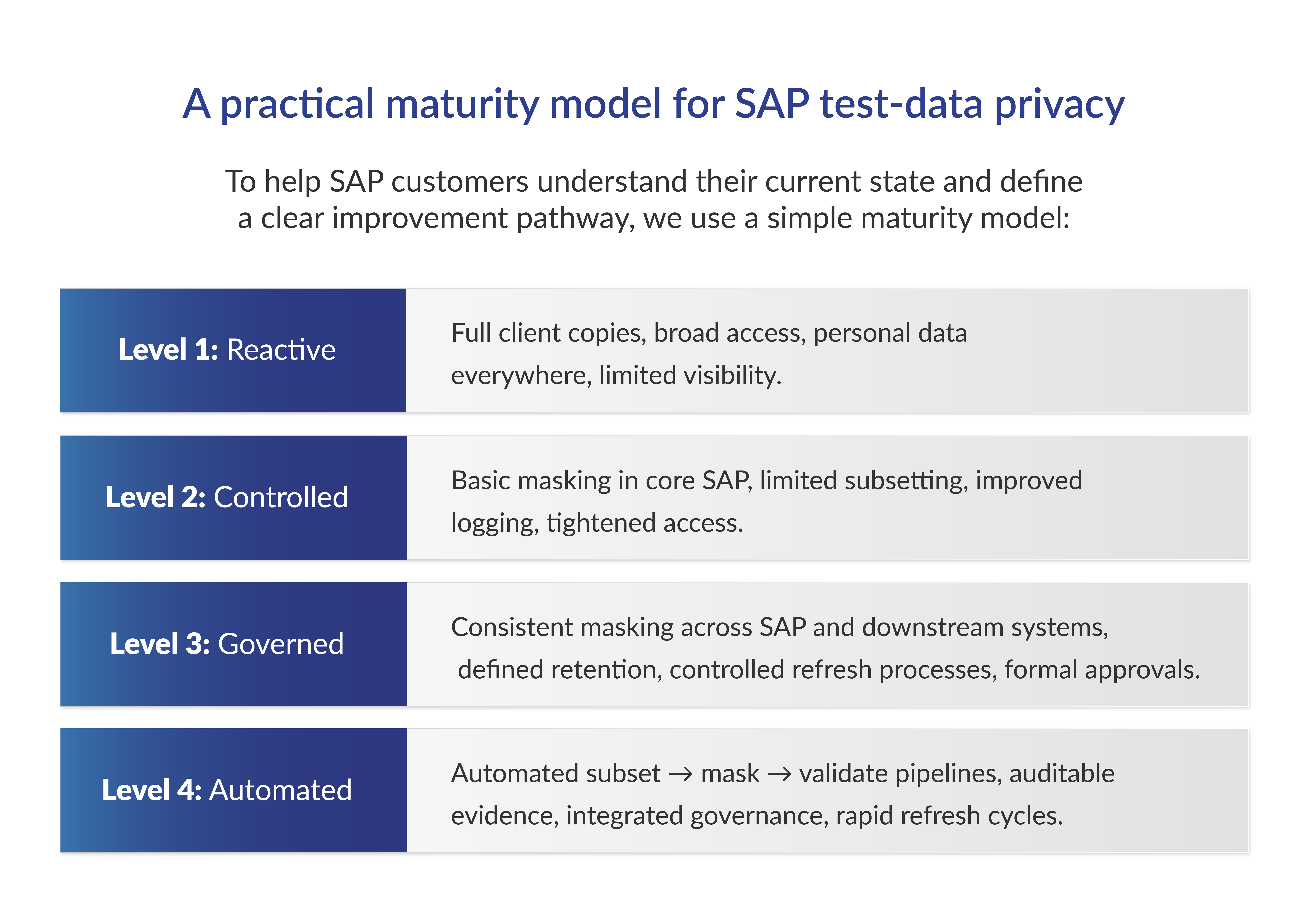
If you'd like a more detailed maturity diagnostic, we can share a comprehensive assessment framework as part of a workshop.
Most organisations sit between Level 1 and Level 2. Levels 3 and 4 become realistic with a structured approach and the right tooling.
Six weeks to clarity: an assessment and roadmap for SAP test-data privacy
Implementing full data masking or governed refresh pipelines across an SAP landscape takes time, but establishing clarity and direction is achievable in a short, structured timeframe.
Week 1: Map your test-data blast radius
Identify all SAP and downstream systems containing personal data. Document integrations, refresh patterns, access privileges, and existing masking coverage.
Week 2: Define realism requirements
Clarify which data elements must remain realistic for key test processes such as hire-to-retire, procure-to-pay, order-to-cash, and payroll.
Week 3: Establish consistent masking rules
Define policy-driven rules for personal information, payroll fields, financial data, vendor and customer identifiers, and bank details.
Week 4: Extend to downstream systems
Apply consistent protection to SAP BW/4HANA, analytics platforms, reporting layers, middleware, and data lakes.
Week 5: Strengthen access and observability
Review vendor, offshore, and privileged access. Ensure logs are captured, retained, and reviewable.
Week 6: Define a secure, automated refresh pipeline
Design a repeatable subset → mask → validate → log process aligned to regulatory expectations and delivery timelines.
Full implementation typically follows this assessment and is tailored to the organisation’s SAP landscape, data flows, integrations, and regulatory requirements. We provide a detailed implementation roadmap during a structured engagement.
How does EPI-USE Labs’ Data Sync Manager (DSM) supports SAP test-data privacy?
These requirements directly align with the capabilities provided by Data Sync Manager (DSM) – a leading SAP test-data platform used across S/4HANA programmes, SAP Payroll transformations, and SAP SuccessFactors integrations.
DSM enables organisations to:
- subset data so non-production environments contain only what is required
- mask sensitive and personal fields consistently across SAP and downstream systems
- automate refresh pipelines, reducing effort from weeks to hours
- safely accelerate delivery without increasing security or compliance risk
- produce auditable evidence for regulatory and internal stakeholders
DSM supports key regulatory principles – including data minimisation, pseudonymisation, purpose limitation, privacy by design, and equivalent protection for replicated datasets – helping SAP customers reduce non-production exposure while improving delivery speed.
Next steps: get visibility into your SAP test-data risk
If you want clarity on where your non-production exposure sits and how to reduce risk without slowing your SAP programme, we can help.
A short workshop can map your landscape and provide a tailored plan for building safe, governed, Production-grade test environments.
Let me know if you’d like help designing your first governed, masked, repeatable SAP test data set.
Frequently Asked Questions (FAQs)
Why is SAP non-production data a data privacy risk?
Because non-production environments often contain replicated personal data without Production-grade controls, creating a significant regulatory and security blind spot.
What is SAP test-data masking?
Masking transforms personal or sensitive fields so they remain realistic for testing while no longer revealing identifiable information.
What tools support SAP data masking and subsetting?
Specialised SAP test-data platforms such as EPI-USE Labs’ Data Sync Manager (DSM) automate masking, subsetting, and governed refresh pipelines.
How does Data Sync Manager (DSM) help with SAP test-data privacy?
DSM provides controlled subsetting, consistent masking, downstream alignment, automated refresh processes, and audit-ready evidence – directly supporting regulatory, audit, and SAP Data Protection and Privacy (DPP) requirements.
Insights from SAP experts and industry leaders
Subscribe today